AI Is Making School Laptops More Expensive
The AI boom is consuming so much computer memory that school laptops are getting significantly more expensive. Some districts are now reconsidering how often devices need replacing and even whether every student still needs one.
AI is arriving in schools through chatbots, tutors, lesson generators and writing assistants.
But it is also affecting classrooms in a much less obvious way:
It is making ordinary laptops more expensive.
Schools across the United States are confronting sharply higher prices for Chromebooks and other student devices as a global shortage of computer memory continues.
The shortage has acquired an appropriately dramatic nickname:
RAMageddon.
And one of the major reasons behind it is the enormous demand for memory created by the AI boom.
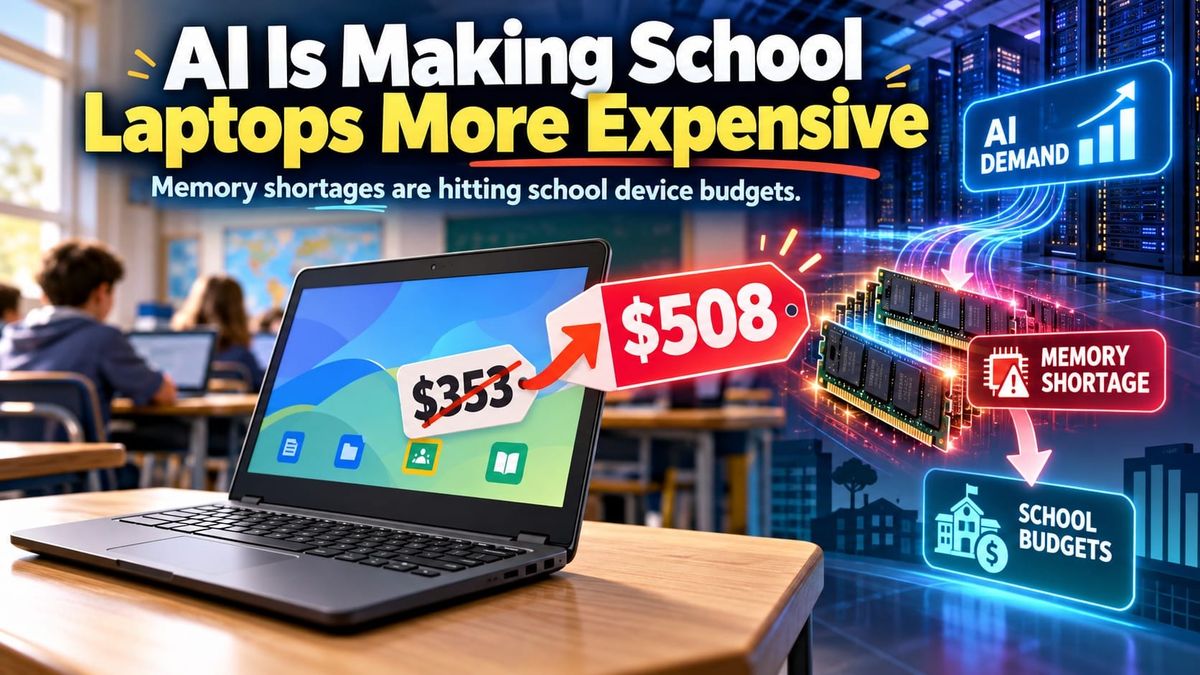
A $353 Chromebook now costs about $508
For school districts buying thousands of devices, relatively small price increases can quickly become enormous budget problems.
One Chromebook configuration cited in recent reporting cost around:
$353 in 2023
Today, a comparable machine costs roughly:
$508
That is an increase of more than 40%.
For a school buying 100 devices, that hurts.
For a district buying 20,000, it becomes a completely different purchasing decision.
Why would AI make a Chromebook expensive?
The answer is inside the machine.
Computers need memory chips.
So do smartphones, game consoles and countless other devices.
But AI data centres need extraordinary quantities of high-performance memory.
As companies race to build bigger AI systems, semiconductor manufacturers have shifted more production capacity toward the specialized memory used in servers and AI infrastructure.
That leaves less capacity for ordinary computer memory.
Less supply.
Huge demand.
Higher prices.
The same AI boom producing new classroom tools is therefore competing indirectly with schools for some of the components inside their basic hardware.
The problem goes beyond RAM
Memory is not the only component affected.
Storage prices have also risen, and manufacturers facing higher costs tend to react in predictable ways:
- raise laptop prices
- reduce specifications
- eliminate cheaper models
- prioritize more profitable devices
That is particularly bad news for education.
Schools are not usually buying premium laptops.
The entire Chromebook model became successful in education partly because districts could put a relatively inexpensive device in the hands of every student.
If the cheapest end of the market disappears, one-to-one computing becomes considerably harder to maintain.
Schools are already changing their plans
Some districts are responding by keeping devices for longer.
Instead of replacing student laptops on the normal cycle, they may extend them another year.
Others are buying equipment earlier than planned to lock in prices.
And some are delaying other technology purchases such as:
- interactive displays
- teacher laptops
- classroom hardware upgrades
That creates another problem.
Older computers are not just slower.
They can eventually create:
- security risks
- compatibility problems
- battery failures
- higher repair costs
So simply keeping everything forever is not much of a solution.
Could one laptop per student become less normal?
This may be the most interesting consequence.
Over the past decade, particularly after the pandemic, many school systems moved toward one device for every student.
The model became almost normal.
But it is expensive.
If hardware costs keep increasing, districts may start asking questions they did not need to ask a few years ago:
Does every student really need a dedicated device all day?
Could some devices be shared?
Which lessons genuinely benefit from laptops?
Which technology purchases actually improve learning?
Ironically, the memory shortage could force schools to become more selective about educational technology.
The AI industry is competing with education for hardware
There is something slightly strange about this situation.
Technology companies are encouraging schools to use more AI.
Schools may therefore need:
- newer devices
- better connectivity
- more digital infrastructure
But the infrastructure required to build AI is simultaneously making ordinary computing hardware more expensive.
The AI boom is helping create both the new educational technology and the shortage affecting the equipment schools need to use it.
That is not a problem a better classroom prompt can solve.
Cheap computing was easy to take for granted
One reason EdTech expanded so quickly was that computing became remarkably inexpensive.
A basic Chromebook could:
- access learning platforms
- run Google Classroom
- play video
- create documents
- take quizzes
- support research
Schools did not need a powerful computer.
They just needed a lot of inexpensive ones.
That economic assumption may now be changing.
Industry analysts say conventional memory prices remain under significant pressure, with AI infrastructure consuming increasing amounts of manufacturing capacity.
Nobody knows exactly how long the shortage will last.
There may be one useful side effect
Schools have accumulated an extraordinary amount of technology.
Some of it is indispensable.
Some of it is useful.
And some of it exists mostly because digital became the default.
More expensive hardware could force a surprisingly healthy question:
Which technology actually deserves a place in the classroom?
If a laptop allows a student to do something genuinely valuable that would otherwise be difficult, the cost may be justified.
If the device is being used to turn a perfectly good paper worksheet into a digital worksheet, perhaps not.
It is an unfortunate way to arrive at that question.
But schools may increasingly have to answer it.
The strange circle of AI in education
For years, the big question has been:
How will AI change what students do on their computers?
Now there is another one:
Will AI make those computers too expensive?
That may sound like a side effect of the AI revolution.
For school technology budgets, it could become a very practical problem.
Sources
The Atlantic: “The Memory Shortage Comes for Schools”
Euronews: “AI demand keeps consumer prices high in ‘RAMaggedon’ chip crunch”
ITPro: Gartner data on PC shipments and rising memory costs