Do Teachers’ Social-Emotional Skills Affect Students? What 65 Studies Found
A new meta-analysis of 65 studies found a moderate relationship between teachers’ and students’ social-emotional skills, suggesting that students may learn as much from how teachers respond as from what they explicitly teach.
Teachers do much more than explain subject content.
They model how to:
stay calm under pressure,
handle conflict,
ask for help,
respond to mistakes,
work with other people,
make decisions,
and manage emotions.
But does any of that actually show up in students?
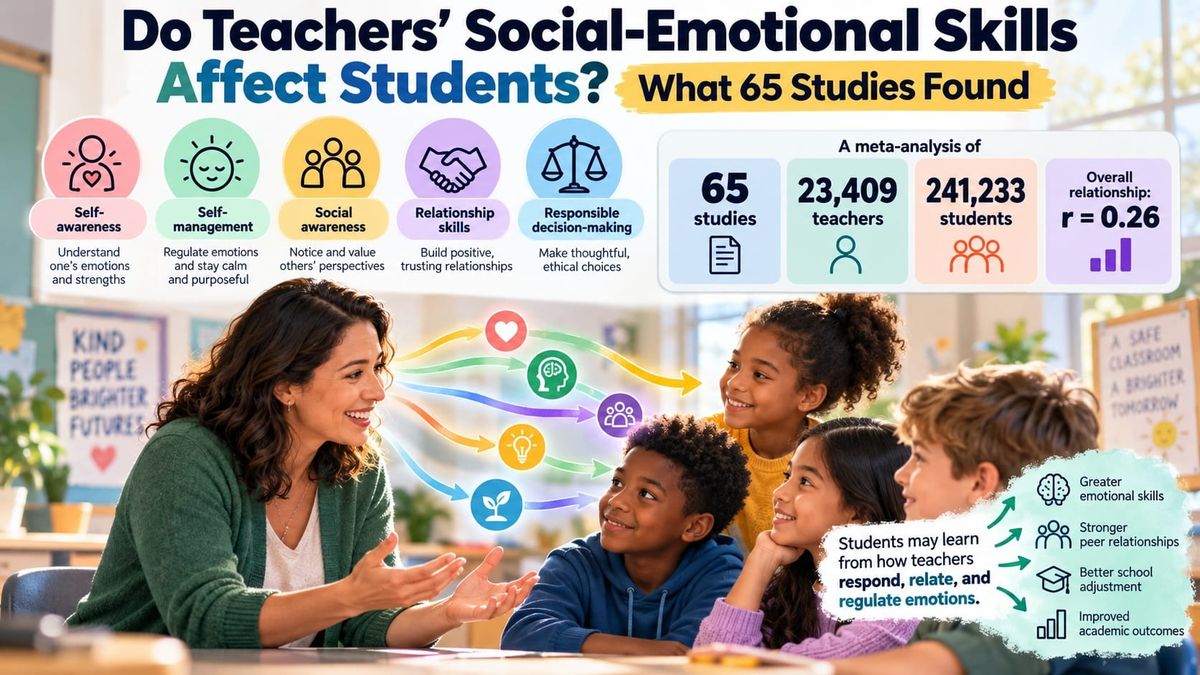
A new 2026 meta-analysis tried to answer that question by combining 65 studies and 196 effect sizes, involving:
- 23,409 teachers
- 241,233 students
The researchers looked at teachers’ and students’ social-emotional competence, including things such as self-awareness, self-management, social awareness, relationship skills and responsible decision-making.
The headline result was:
Teachers with stronger social-emotional competence tended to have students with stronger social-emotional competence too.
The overall association was:
r = 0.26
That is a moderate relationship.
Not huge.
But large enough to suggest that the social and emotional side of teaching may matter beyond classroom atmosphere.
Read the full open-access study
The short version
The meta-analysis found that:
- 65 studies were included
- 196 effect sizes were analyzed
- the evidence covered 23,409 teachers and 241,233 students
- the overall relationship between teacher and student social-emotional competence was r = 0.26
- teachers’ responsible decision-making showed the strongest association with students’ overall social-emotional competence
- students’ relationship skills showed the strongest association with teachers’ overall competence
- results varied substantially across studies
- student socioeconomic status, teacher experience, grade level and measurement method all influenced the strength of the relationship
- publication bias could not be ruled out
The practical takeaway is not:
“Emotionally skilled teachers automatically create emotionally skilled students.”
It is:
The way teachers regulate, relate and respond appears to be part of the social-emotional environment students learn from.
What counts as social-emotional competence?
The researchers organized the evidence around five areas commonly used in the CASEL framework.
Self-awareness
Recognizing your own:
- emotions
- thoughts
- strengths
- limitations
Self-management
Being able to:
- regulate emotions
- manage stress
- control impulses
- stay motivated
Social awareness
Understanding:
- other people’s perspectives
- emotions
- social expectations
- available support
Relationship skills
Being able to:
- communicate
- cooperate
- resolve conflict
- build constructive relationships
Responsible decision-making
Making decisions based on:
- consequences
- ethics
- safety
- social context
These skills apply to both teachers and students.
The interesting question is whether the two are connected.
Overall, they were
Across the full dataset, the average correlation between teacher and student social-emotional competence was:
r = 0.26
That means classrooms with teachers scoring higher on these competencies also tended to have students scoring higher.
But the authors emphasize that the effect varied considerably across studies.
So this is not a fixed rule.
Teacher social-emotional competence is only one influence among many.
Students also bring:
- temperament
- family experiences
- peer relationships
- prior skills
- school climate
- cultural context
Still, the relationship was consistent enough to remain significant across multiple sensitivity checks.
Responsible decision-making stood out
When the researchers separated the teacher competencies, one result was particularly interesting.
Teachers’ responsible decision-making had the strongest association with students’ overall social-emotional competence:
r = 0.39
That was stronger than:
- teacher self-awareness: r = 0.28
- self-management: r = 0.24
- social awareness: r = 0.15
Teacher relationship skills, surprisingly, were not significantly related to students’ overall social-emotional competence in this analysis.
That may sound counterintuitive.
But “responsible decision-making” in teaching can show up constantly.
A teacher decides:
- how to respond to conflict
- whether to punish or investigate
- how to handle unfair behaviour
- when to intervene
- how to balance individual and group needs
- how to react to mistakes
Students observe those decisions every day.
Students’ relationship skills showed the strongest connection
Looking in the opposite direction, students’ relationship skills had the strongest association with overall teacher social-emotional competence:
r = 0.35
Students’ social awareness came next:
r = 0.30
Then self-awareness:
r = 0.25
Self-management showed a smaller relationship:
r = 0.17
Responsible decision-making was weakest:
r = 0.12
That pattern suggests the teacher-student connection may be especially visible in the way students relate to other people.
Again, the authors caution that the number of effect sizes was uneven across these categories, so these rankings should not be treated as precise league tables.
Teachers may model these skills without explicitly teaching them
One of the most interesting parts of the paper is the mechanism.
Students do not learn social-emotional skills only through formal SEL lessons.
They also observe how adults behave.
Imagine a group disagreement.
One teacher responds by:
- staying calm
- naming the problem
- listening to both sides
- helping students identify possible solutions
Another responds by:
- becoming visibly frustrated
- shutting the discussion down
- issuing a punishment immediately
Both teachers are teaching something.
Even if neither intended to.
This is what researchers mean when they talk about teachers as socializers of emotion and behaviour.
Students learn not only from what teachers say.
They also learn from how teachers respond.
Co-regulation may matter too
There is another useful idea in the research: co-regulation.
Students do not always regulate themselves independently.
A teacher can help them do it.
For example:
“You’re frustrated. Let’s work out which part is causing the problem.”
or:
“Take a minute, then tell me what you need.”
The teacher is temporarily helping structure the student’s emotional or behavioural response.
Over time, the student may become better at doing that independently.
That creates a plausible pathway from teacher competence to student competence.
The relationship may work both ways
This is important.
The research does not show a simple one-way chain:
good teacher skills → good student skills
Students also affect teachers.
A class with strong relationship skills, emotional regulation and cooperation may make it easier for a teacher to:
- stay calm
- build relationships
- manage the classroom
- feel effective
A highly dysregulated class may do the opposite.
So the relationship may be partly reciprocal.
Teachers shape students.
Students shape teachers.
And both are influenced by the school environment around them.
Context mattered
The strength of the relationship changed depending on several factors.
The researchers found moderating effects for:
- student socioeconomic status
- teacher experience
- grade level
- how social-emotional competence was measured
That matters because social-emotional competence is difficult to measure.
A self-report questionnaire asks:
“How good are you at regulating emotions?”
An observation asks:
“What does this person actually do?”
Those are not the same thing.
Some studies relied on teacher reports.
Others used student reports or observations.
The method affected the result.
Publication bias is a real caveat
The authors also found signs that publication bias could not be ruled out.
That means studies finding a positive relationship may have been more likely to appear in the published literature than studies finding little or no relationship.
The overall estimate of r = 0.26 should therefore be treated cautiously.
The relationship is probably real.
But its exact size may be less certain.
This is one reason the researchers call for more longitudinal and experimental work.
Does this mean schools should teach teachers SEL?
Possibly.
But the evidence here does not prove that training teachers in social-emotional skills will automatically improve students’ skills.
That is a different question.
This meta-analysis shows association.
It does not establish a guaranteed causal pathway.
Still, it suggests that teacher development should perhaps include more than:
- subject knowledge
- lesson planning
- assessment
- classroom technology
Teachers also work in an intensely social environment.
Their ability to regulate themselves, respond to conflict and build relationships may shape what students experience every day.
This is not about making teachers permanently calm
There is a danger in turning research like this into another impossible expectation.
Teachers are human.
They become frustrated.
They get tired.
They have bad days.
Social-emotional competence does not mean:
never show emotion.
It means being able to recognize and manage emotion well enough to respond constructively.
Students do not need emotionally perfect adults.
They may benefit more from seeing adults:
- notice mistakes
- apologize
- recover from frustration
- reconsider decisions
- repair relationships
Those behaviours are social-emotional skills too.
A useful classroom question
Teachers might ask themselves:
What do students learn from the way I respond when something goes wrong?
Not from the lesson plan.
From the response.
When a student gives a wrong answer.
When two students argue.
When technology fails.
When the class becomes noisy.
When the lesson does not work.
Those moments may teach students more about emotional regulation and decision-making than a dedicated worksheet ever could.
The bigger lesson
Social-emotional learning is often treated as something we teach to students.
This meta-analysis suggests that may be incomplete.
Across 65 studies and more than 240,000 students, teachers’ own social-emotional competence was moderately associated with students’ competence.
The relationship is messy.
It varies by context.
It is probably reciprocal.
And the evidence is still mostly correlational.
But the basic idea is difficult to ignore:
Students learn social and emotional behaviour partly by living inside a classroom where adults model it every day.
Sometimes the teacher is not only teaching the lesson.
The teacher is part of the lesson.
Source
Nguyen, T.-A., Hidajat, T., Zhou, T., Ma, T., Hoang, A., Poed, S. et al. (2026).
Relations between Teachers’ and Students’ Social-emotional Competence: A Systematic Review and Multilevel Meta-analysis. Educational Psychology Review, 38, 126.