AI Feedback vs Human Feedback: What 41 Studies Actually Found
A 2025 meta-analysis of 41 studies and 4,813 students found no significant overall difference between AI and human feedback. The details explain why the answer is more complicated than it sounds.
AI can now comment on essays, suggest revisions, explain mistakes and generate feedback almost instantly.
That makes an obvious question increasingly important:
Is AI feedback actually as good as feedback from a teacher or another person?
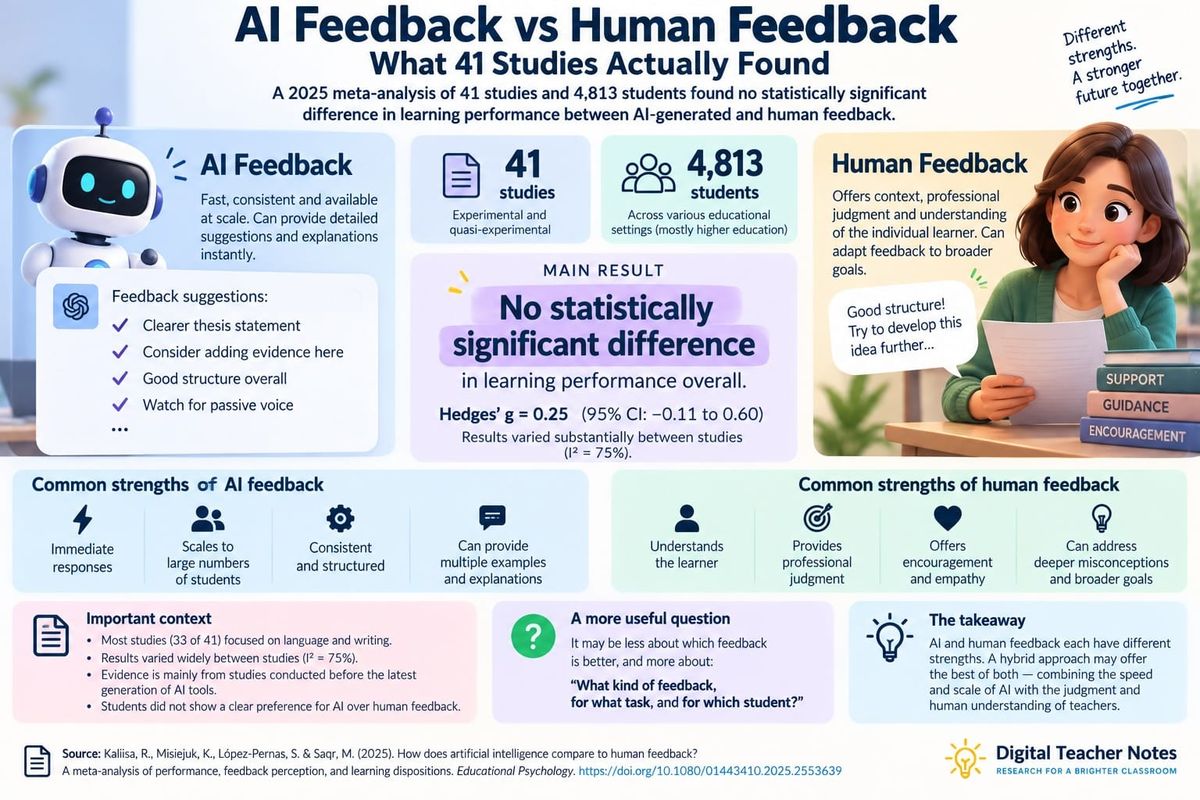
A 2025 meta-analysis tried to answer that by combining results from 41 studies involving 4,813 students.
The headline result is surprisingly simple:
The researchers found no statistically significant difference in learning performance between AI-generated and human feedback overall.
But that does not mean AI has “caught up with teachers” in every situation.
The details are much more interesting.
The short version
The meta-analysis found that:
- 41 studies were included
- 4,813 students participated across those studies
- AI feedback and human feedback produced no statistically significant difference in learning performance overall
- For task performance, the pooled effect was g = 0.25, but the confidence interval crossed zero
- Results varied substantially between studies
- Most of the research focused on language and writing
- Students did not clearly prefer AI feedback over human feedback either
- The researchers suggest that a hybrid approach may be more useful than treating AI and human feedback as competitors
So the interesting conclusion is not:
“AI feedback is better.”
or even:
“AI feedback is just as good.”
A more careful interpretation is:
In the studies available so far, AI feedback often performed in the same general range as human feedback, but the results were highly dependent on context.
41 studies, 4,813 students
The researchers reviewed studies comparing AI-generated feedback with feedback from teachers or peers.
The studies covered different kinds of AI systems and different educational settings.
But one area dominated the evidence.
Of the 41 studies:
33 focused on language and writing.
Most of those were in higher education.
Only a small number looked at K–12 settings or other subjects.
That matters.
AI may be relatively well suited to tasks such as identifying grammar problems, suggesting revisions or commenting on writing structure.
That tells us much less about whether it can provide equally useful feedback in areas such as science reasoning, history essays, creative work or complex classroom discussion.
Learning performance was not significantly different
The researchers looked at several different outcomes.
For studies measuring task performance after receiving feedback, the pooled difference between AI and human feedback was:
Hedges' g = 0.25
That result was not statistically significant.
The confidence interval ranged from -0.11 to 0.60.
In practical terms, the meta-analysis could not establish a reliable advantage for either AI or human feedback.
The researchers also looked at studies measuring improvement from before to after feedback.
Again, they found no significant difference.
But the results varied enormously
This is probably the most important caveat.
The studies did not all produce similar results.
For task performance, heterogeneity was:
I² = 75%
In the language-and-writing analysis of learning gains, it was even higher:
I² = 95%
That means the effect of AI feedback varied substantially depending on the particular study.
Some contexts may suit AI feedback very well.
Others may not.
So a single statement such as:
“AI feedback works as well as human feedback”
hides a lot of variation.
A better question is:
What kind of feedback, for what task, for which student?
Students did not clearly prefer AI feedback either
Learning performance is only part of the picture.
Feedback also has to be understood, trusted and acted upon.
The researchers therefore examined how students perceived AI and human feedback.
Again, there was no statistically significant difference.
The pooled effect was:
g = -0.20
with a confidence interval from -0.67 to 0.27.
The direction slightly favored human feedback, but the result was too uncertain to support a firm conclusion.
That is interesting because AI has several obvious advantages from a student's perspective.
It is fast.
It can respond immediately.
It does not get tired.
A student may also feel less embarrassed asking an AI system to explain the same mistake five times.
But human feedback can offer something AI may struggle with.
A teacher knows the student.
They understand what has already been taught.
They can notice frustration, confidence or misunderstanding.
They can decide that the student does not need another correction, but a different explanation entirely.
AI feedback is extremely scalable
Even if AI feedback is not clearly better, it has one major practical advantage.
It is cheap and immediate at scale.
A teacher may have 30 essays to review.
An AI system can respond to 30 essays almost instantly.
That creates possibilities that would be difficult to provide manually.
Students could receive an initial round of feedback while drafting.
They could ask for clarification.
They could try again before submitting their final work.
AI could also handle simpler forms of feedback while teachers concentrate on areas where professional judgment matters more.
This is one reason the comparison between AI and human feedback may eventually be the wrong question.
The more interesting model may be AI plus teacher
The authors themselves argue for a hybrid approach.
AI can provide:
- speed
- scale
- repeated feedback
- immediate responses
Humans can provide:
- context
- judgment
- empathy
- knowledge of the learner
- understanding of classroom goals
The strongest use of AI feedback may therefore not be replacing the teacher.
It may be changing when the teacher needs to intervene.
For example:
AI: identify possible grammar problems.
Student: decide which suggestions make sense.
Teacher: comment on argument, reasoning and overall quality.
Or:
AI: give immediate feedback on a first attempt.
Student: revise.
Teacher: focus on the revised version and the deeper misconceptions that remain.
That is very different from asking AI to make the final judgment.
There is another important limitation
The studies in this meta-analysis cover research conducted before the very latest generation of AI tools became widespread.
The dataset includes studies up to early 2024.
That means much of the evidence does not necessarily represent the current generation of large language models being used in classrooms today.
At the same time, newer models do not automatically make the older evidence irrelevant.
The basic educational question remains the same:
Does the feedback help the student understand what to improve and actually improve it?
A more fluent answer is not necessarily a more educationally useful one.
So is AI feedback as good as human feedback?
Based on these 41 studies, the safest answer is:
Sometimes it may be.
The meta-analysis found no reliable overall difference in learning performance.
But the enormous variation between studies means the result should not be interpreted as proof that AI and human feedback are interchangeable.
The task matters.
The subject matters.
The type of AI matters.
The student matters.
And perhaps most importantly, the purpose of the feedback matters.
AI may be particularly useful when students need quick, repeated feedback during practice.
Human feedback may matter most when learning requires interpretation, judgment, encouragement or a deep understanding of the individual student.
The future of feedback may therefore be less about choosing between AI and humans.
It may be about deciding which feedback deserves a human.
Source
Kaliisa, R., Misiejuk, K., López-Pernas, S. & Saqr, M. (2025).
How does artificial intelligence compare to human feedback? A meta-analysis of performance, feedback perception, and learning dispositions. Educational Psychology.