AI in Education: 7 Key Takeaways from the OECD’s 267-Page Report
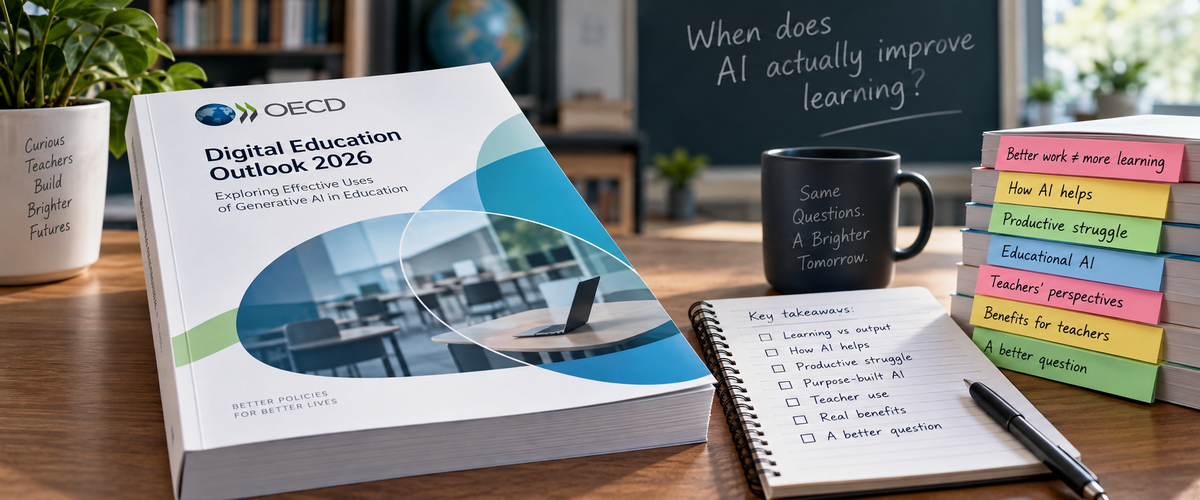
AI can help students produce better work. That doesn’t necessarily mean they’re learning more.
That may be the most important takeaway from the OECD Digital Education Outlook 2026, a 267-page report published in January that looks at emerging evidence on generative AI in education.
The report is refreshingly different from much of the conversation around AI in schools. It isn’t particularly interested in whether AI is exciting, inevitable, frightening, or revolutionary. It asks a more useful question:
When does generative AI actually improve learning?
I read through the report. Here are seven things I think teachers should take away from it.
The full report is freely available from the OECD:
OECD Digital Education Outlook 2026: Exploring Effective Uses of Generative AI in Education
The 7 takeaways at a glance
Short on time? Here’s the whole article in seven points. Click any one to jump to the full explanation.
- Better work does not necessarily mean more learning — AI can improve the quality of students’ work without producing the same improvement in what they can do independently.
- The difference may be how AI helps — AI designed to guide students with hints and questions is very different from simply giving them answers.
- Productive struggle still matters — making a task easier and faster can sometimes remove the cognitive effort that helps learning happen.
- Purpose-built educational AI looks more promising — the most useful educational AI may be designed around learning rather than around answering anything.
- Teachers are already using AI — but they’re not blind to the problems — teachers are finding practical uses for AI while remaining concerned about issues such as academic integrity.
- AI may be immediately valuable on the teacher side — some of the clearest benefits today may be reducing planning workload and supporting less-experienced educators.
- “AI in education” may simply be too broad a question — what matters is not whether AI is used, but what role it plays in the learning process.
1. Better work does not necessarily mean more learning
This is the finding that stayed with me.
Give students access to a general-purpose AI tool and, unsurprisingly, they can often produce better answers. Essays improve. Problems get solved. Tasks get completed more successfully.
But what happens when you take the AI away?
The OECD reviews emerging evidence showing that the performance advantage can disappear — and in some cases reverse — when students later have to demonstrate the same skills without AI.
One experiment discussed in the report is particularly striking. Students in Türkiye using GPT-4 performed substantially better during practice. But students who had used the standard GPT-4 interface subsequently performed 17% worse when AI access was removed.
That’s an uncomfortable result.
We usually infer learning from output. A student produces a better essay, so we assume something good happened. A student answers more questions correctly, so we assume they understand the material better.
AI makes that assumption much less reliable.
The work can improve while the learner doesn’t.
2. The difference may be how AI helps
The same experiment provides an important qualification.
A specially designed AI tutor also dramatically improved students’ performance during practice — even more than unrestricted GPT-4. But unlike the standard chatbot, it was designed to guide students rather than simply provide answers.
That’s a recurring theme throughout the OECD report.
The question isn’t simply:
Should students use AI?
A better question is:
What is the AI asking the student to do?
An AI system that asks questions, provides hints, challenges an argument or adapts an explanation can require the learner to keep thinking.
An AI system that turns a question into an answer can remove the thinking altogether.
Both are “using AI in education.” Pedagogically, they’re very different activities.
3. Productive struggle still matters
There’s a wonderfully unfashionable idea running through the report: sometimes learning is supposed to be difficult.
Reading a complicated passage, trying to remember something, constructing an argument and struggling with a problem all require cognitive effort.
Generative AI is exceptionally good at removing that effort.
Usually that’s exactly why we like it.
But in education, removing friction can also remove part of the mechanism through which learning happens.
The OECD discusses the risk of students offloading cognitive tasks and developing what researchers have described as “metacognitive laziness” — becoming less inclined to monitor, question and regulate their own thinking.
That doesn’t mean deliberately making every task harder.
It means we shouldn’t automatically treat “the student completed this faster” as evidence that technology improved the learning experience.
Sometimes the struggle is the experience.
4. Purpose-built educational AI looks more promising
One distinction in the report deserves more attention than it usually gets: general-purpose AI versus educational AI.
ChatGPT, Claude, Gemini and similar tools weren’t fundamentally designed around how people learn. They’re extraordinarily capable general-purpose systems.
Educational AI can work differently.
A tutor might refuse to reveal the answer immediately. It might diagnose a misconception, ask a simpler question, provide a hint, or deliberately move a student through a sequence.
The OECD finds more encouraging evidence when AI is designed or used with an explicit pedagogical purpose.
This suggests that the most interesting educational AI of the next few years may not be the chatbot with the longest feature list.
It may be the one that knows when not to answer.
5. Teachers are already using AI — but they’re not blind to the problems
The report includes some useful numbers from TALIS 2024.
37% of lower-secondary teachers reported using AI for their work.
Meanwhile:
57% agreed that AI can help write or improve lesson plans.
And:
72% believed AI can harm academic integrity by allowing students to present work they didn’t create themselves.
Those numbers paint a more nuanced picture than the usual “teachers embrace AI” versus “teachers resist AI” debate.
Many teachers seem perfectly capable of holding two ideas at once:
AI can be useful.
AI can create serious problems.
That’s probably the sensible position.
6. AI may be immediately valuable on the teacher side
Some of the report’s most practical findings aren’t about students using AI at all.
In one study cited by the OECD, secondary science teachers in England using generative AI for lesson and resource preparation reduced planning time by 31%.
That’s significant.
If AI helps draft a worksheet, restructure an explanation, generate examples or prepare a first version of lesson materials, the teacher remains in a position to evaluate the result.
There’s still a risk of bad output, of course. But the relationship is different.
The teacher isn’t necessarily outsourcing the skill they’re supposed to be learning.
They’re using a tool to reduce workload.
The report also discusses evidence of AI assisting less-experienced tutors. In one example, AI support was associated with a 9-percentage-point increase in student pass rates for tutors with lower experience, while the effect was smaller for more experienced tutors.
That points toward a potentially powerful role for AI: not replacing educators, but helping people perform difficult educational tasks better.
7. “AI in education” may simply be too broad a question
After 267 pages, this is perhaps the conclusion I found most useful.
Asking whether AI is good for education is a little like asking whether computers are good for education.
It depends entirely on what we’re doing with them.
Using AI to write an essay for a student is not the same as using it to critique the student’s argument.
Generating the answer to a mathematics problem is not the same as providing the next hint.
Creating a lesson-plan draft for an experienced teacher is not the same as automatically deciding what a class should learn.
The OECD’s evidence doesn’t support a simple story in which AI either transforms learning or destroys it.
Instead, a much more practical rule emerges:
AI seems most useful when it supports thinking rather than replacing it.
The question I’d ask before using AI with students
The report left me with a very simple test.
Before introducing an AI tool into an activity, ask:
What thinking would the student have to do without this tool — and will they still do that thinking with it?
If AI removes formatting, repetitive work or unnecessary friction, great.
If it provides feedback, asks useful questions or helps a student get unstuck, potentially even better.
But if the most important intellectual part of the task quietly moves from the student to the machine, a better final product may be disguising a worse learning experience.
That’s a distinction worth paying attention to as AI becomes a normal part of the classroom.
Source: OECD (2026), OECD Digital Education Outlook 2026: Exploring Effective Uses of Generative AI in Education. Published 19 January 2026.