Badges, Flashing Lights and AI: When EdTech Looks Better Than It Teaches
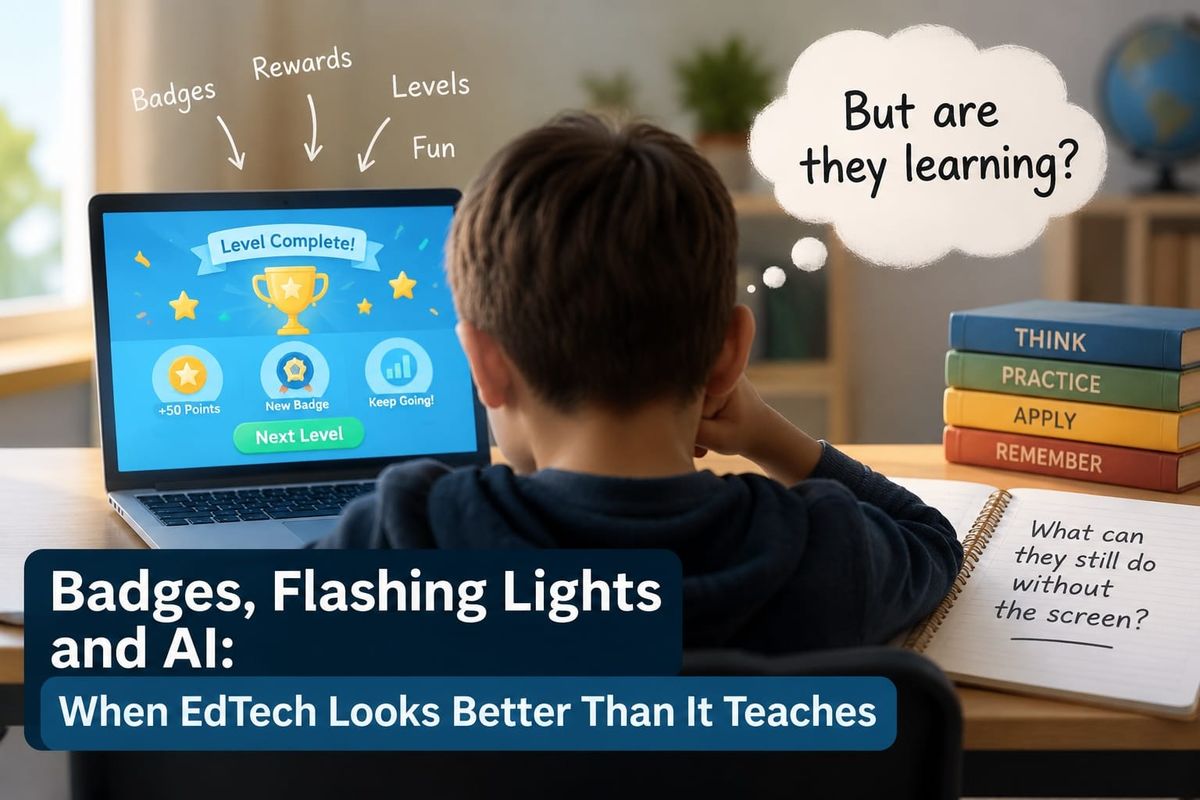
A student is clicking, earning badges and completing levels.
The app says they are engaged.
But are they actually learning?
A new report from the American Psychological Association says schools and families should be careful not to confuse the two.
Published on September 3, the report argues that educational technology should be judged by what students can actually retain and apply, not by how much they click, how long they stay in an app, or how much they seem to enjoy it.
Engagement is not the same as learning
This is the report's central message.
A student can be highly active inside an app without building durable knowledge.
They might respond to animations, collect rewards, complete tasks and stay focused for a long time.
That can look impressive in an analytics dashboard.
But the APA says the stronger test is what happens afterwards.
Can the student still use the knowledge when the app is closed?
That is a much better measure of learning.
Some “fun” features can become distractions
The report also warns that features designed to capture attention can sometimes pull attention away from the learning itself.
That includes things such as:
- rewards
- collectibles
- animations
- flashing images
- decorative interactions
The APA gives parents a surprisingly practical suggestion:
Spend a minute watching what actually happens inside the app.
If much of the experience is about dressing characters, choosing accessories, collecting rewards or reacting to visual effects, it is reasonable to ask how much of the activity is actually educational.
That does not mean educational games are bad.
It means engagement should serve the learning goal, not compete with it.
AI creates a new version of the same problem
The report makes a similar distinction with generative AI.
A student may produce a better essay with AI.
But that does not necessarily mean they have become a better writer.
The final product can improve while the student's independent knowledge or skill does not.
So alongside:
engagement vs learning
schools may increasingly need to think about:
performance vs learning
That distinction matters because AI can make student work look stronger very quickly.
The educational question is whether the student is also becoming more capable without the tool.
The APA is not arguing against EdTech
The report is not anti-technology.
It says educational technology can support learning, but its value depends on how it is designed, what students are asked to do, what it replaces, and how adults integrate it.
The APA makes ten recommendations, including choosing tools based on learning outcomes, using simpler designs, preventing unnecessary multitasking, involving adults in implementation, and being especially careful with generative AI.
It also argues that schools should expect credible evidence before adopting products that claim to improve learning.
That seems like a reasonable standard.
A very simple test
Perhaps the most useful idea in the report can be reduced to one question:
What can the student still do when the technology disappears?
Close the app.
Remove the AI assistant.
Take away the hints.
Can the student explain the idea?
Solve a similar problem?
Remember what they learned?
Apply it somewhere new?
If yes, the technology probably supported learning.
If not, the student may have been very engaged without learning very much.
Sources
American Psychological Association: Children’s and adolescents’ learning with educational technology