Can Student Feedback Actually Improve Teaching? What 23 Studies Found
A 2025 meta-analysis of 23 studies found that student feedback can improve teaching, but the biggest gains came when teachers were helped to turn feedback into action.
Students receive feedback constantly.
Teachers comment on assignments, correct mistakes, suggest improvements and explain what students should do differently next time.
But feedback can go in the other direction too.
What happens when students give feedback to teachers?
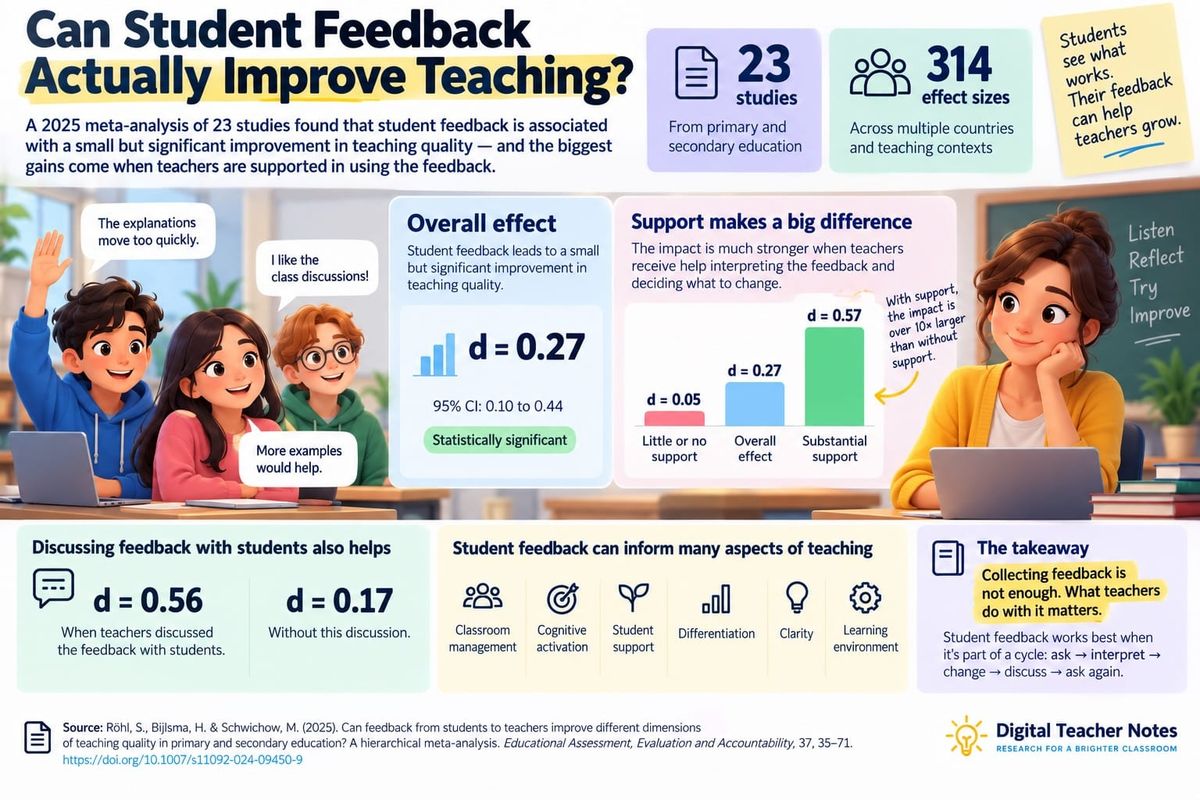
A 2025 meta-analysis looked at 23 studies and 314 effect sizes from primary and secondary education.
The overall finding was positive:
Student feedback was associated with a small but statistically significant improvement in teaching quality.
The average effect was:
d = 0.27
That is not a dramatic transformation.
But the more interesting part of the study is what happened when researchers looked at how the feedback was used.
Read the full open-access meta-analysis
The short version
The meta-analysis found that:
- 23 studies were included
- 314 effect sizes were analyzed
- The average effect of student feedback on teaching quality was d = 0.27
- Feedback worked much better when teachers received support interpreting it and deciding what to change
- Teachers who received substantial guidance showed an effect of d = 0.57
- Teachers with little or no support showed an effect of only d = 0.05
- Discussing the feedback with students was also associated with stronger improvements
- Effects appeared across many different aspects of teaching, not just one specific classroom practice
The practical lesson is simple:
Collecting feedback is not enough. What teachers do with it matters much more.
23 studies, 314 effect sizes
The researchers searched nearly 1,500 publications before selecting 23 studies that met their criteria.
The studies involved teachers in primary and secondary education.
Some were conducted in the United States, others in Australia, Germany and several other countries.
The researchers focused specifically on interventions where teachers received feedback from students and then had an opportunity to improve their teaching.
This matters because the study was not simply asking whether students can accurately rate their teachers.
It was asking a more useful question:
Does giving teachers student feedback actually change teaching?
The overall effect was positive
Across the studies, the weighted average effect was:
d = 0.27
The confidence interval ranged from 0.10 to 0.44, and the result was statistically significant.
That suggests student feedback can improve teaching quality.
But an effect of 0.27 is relatively modest.
If that were the entire story, the conclusion would be:
Student feedback helps a little.
The moderator analysis makes the result much more interesting.
Support made a huge difference
Some teachers simply received the feedback.
Others received help understanding what it meant and deciding how to respond.
That difference was substantial.
When teachers were given suggestions for areas of improvement and guidance on changing their teaching, the effect was:
d = 0.57
When teachers received no support, or only basic help interpreting the statistics, the effect was:
d = 0.05
That is a very large difference.
It suggests that giving a teacher a survey report and saying:
“Here are your results.”
may accomplish very little.
The feedback becomes more useful when teachers are helped to translate it into action.
Feedback needs a next step
Imagine students say:
“The explanations move too quickly.”
That information might be useful.
But what should the teacher actually change?
Slow down every lesson?
Add more examples?
Pause after each concept?
Use more checks for understanding?
Ask students to explain ideas back?
Feedback identifies a possible problem.
It does not automatically identify the best solution.
This may explain why structured support mattered so much.
Teachers often need time, discussion or coaching to move from:
“Students say this is a problem.”
to:
“Here is what I will try differently next week.”
Talking about the feedback with students also helped
Another interesting finding involved what happened after teachers received feedback.
Studies where teachers were encouraged or required to discuss the feedback with their students showed a larger effect:
d = 0.56
Studies without this discussion showed a much smaller effect:
d = 0.17
The researchers caution that this finding overlaps with the support effect, because many studies that encouraged classroom discussion also provided strong support to teachers.
So we should not treat these numbers as completely independent.
Still, the pattern is useful.
Closing the feedback loop may matter.
A teacher might say:
“Several of you said instructions for independent work were unclear. I’m going to start showing an example before you begin. Tell me in two weeks whether that helps.”
Now students can see that their feedback had a purpose.
And the teacher has created a concrete experiment rather than simply collecting opinions.
Student feedback worked across different parts of teaching
The researchers also looked at whether student feedback worked better for particular aspects of teaching quality.
Overall, they found positive effects across many areas.
These included things such as:
- classroom management
- cognitive activation
- student support
- differentiation
- clarity
- learning environment
There were some differences, but most were relatively small.
That suggests student feedback is not useful only for obvious questions such as:
“Was the lesson clear?”
Students may be able to provide useful information about several dimensions of their classroom experience.
But students are not professional observers
This is an important limitation.
Students experience teaching directly.
That gives them information nobody else has.
They know whether instructions feel clear.
They know whether they feel comfortable asking questions.
They know whether lessons feel rushed or repetitive.
But students are not trained teaching evaluators.
They may dislike an activity because it is difficult.
They may enjoy a lesson that feels entertaining without learning much.
They may also judge a teacher based on personality, grades or other factors unrelated to teaching quality.
So student feedback should probably not be treated as a final verdict.
It is better understood as one source of evidence.
The questions matter too
The meta-analysis also found that the design of feedback questionnaires influenced results.
For example, studies using frequency-based response scales tended to show stronger effects.
A question like:
“How often does the teacher explain what we are expected to learn?”
may be more useful than:
“Is your teacher good at explaining?”
The first asks students about an observable behaviour.
The second asks for a general judgment.
That distinction matters.
Specific questions are easier to act on.
A simple classroom version
A teacher does not necessarily need a sophisticated survey system.
A short anonymous questionnaire could ask:
1. What helps you understand new ideas in this class?
2. When do you most often get confused?
3. What should we do more often?
4. What should we do less often?
5. Is there one small change that would help you learn better?
Then comes the important part.
Do not simply collect the answers.
Look for patterns.
Choose one or two realistic changes.
Tell students what you noticed.
Try something different.
Then ask again later.
That creates a cycle:
Ask → interpret → change → discuss → ask again.
Feedback should create a conversation
The most interesting finding from this meta-analysis may not be the average effect size.
It is the difference between collecting feedback and using feedback.
Student feedback can improve teaching.
But the strongest effects appeared when teachers were supported in understanding the feedback, translating it into specific changes and discussing those changes with students.
So perhaps the useful question is not:
“Should teachers ask students for feedback?”
It is:
“What happens after the students answer?”
Source
Röhl, S., Bijlsma, H. & Schwichow, M. (2025).
Can feedback from students to teachers improve different dimensions of teaching quality in primary and secondary education? A hierarchical meta-analysis. Educational Assessment, Evaluation and Accountability, 37, 35–71.