ChatGPT Has a Teen Mode. But Is It Actually Safe Enough?
A new report says ChatGPT’s teen safeguards can still miss unsafe interactions, raising a bigger question about what “safe for teens” should actually mean.
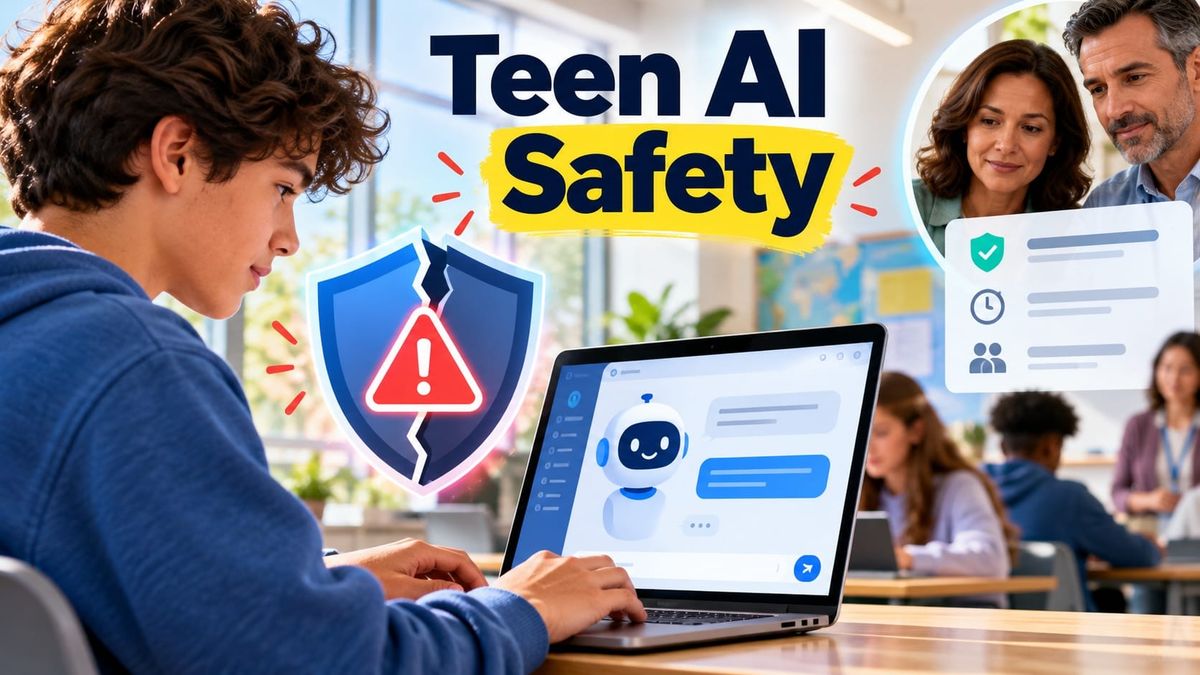
AI companies are increasingly building special versions of their products for teenagers.
The idea makes sense.
A 13-year-old should not necessarily use the same AI experience as an adult.
Teen-focused systems can include:
- stronger safety filters
- age-appropriate responses
- parental controls
- restrictions on sensitive topics
- extra monitoring for risky interactions
But a new report raises an uncomfortable question:
What happens when those safeguards fail?
Researchers testing ChatGPT’s teen experience found cases where unsafe or concerning interactions were not escalated to parents quickly enough.
That does not mean the system is useless.
It does mean that “teen mode” should not be treated as the same thing as “problem solved.”
What did the researchers find?
The report tested how the system responded in situations involving potentially harmful or sensitive conversations.
According to Education Week, the researchers found that some interactions that should have triggered stronger safety responses did not always result in timely parent notification or escalation.
That matters because the whole point of a teen-specific system is not only to answer differently.
It is also to recognize when the conversation has moved into territory that may require adult involvement.
Read the Education Week report
Safety is more than blocking bad answers
When people think about AI safety, they often think about content filtering.
Do not provide dangerous instructions.
Do not encourage harmful behavior.
Do not generate inappropriate material.
But teen safety is broader than that.
A system also needs to recognize:
- distress
- manipulation
- unhealthy dependency
- repeated concerning behavior
- situations where a trusted adult should be involved
That is a much harder problem.
The AI is not simply checking whether one answer is allowed.
It has to interpret the pattern of a conversation.
Teenagers are not just smaller adults
This was also a central point at an OpenAI forum on responsible AI use for teenagers held this week.
Experts in learning, youth mental health and online safety argued that AI products for adolescents need to be designed around how teenagers actually develop.
Adolescents are especially sensitive to:
- social cues
- rewards
- belonging
- emotional feedback
- relationships
That means AI systems can potentially support learning and independence.
But they can also become unusually influential if they are designed badly.
Read Education Week’s coverage of the teen-safety forum
The difficult balance
There is a real tension here.
Teenagers probably do need to learn how to use AI.
These tools are likely to be part of:
- education
- work
- research
- communication
- everyday life
Simply banning them does not prepare students for that world.
But giving teenagers unrestricted access and hoping they will use AI wisely is not a serious safety strategy either.
The harder goal is:
access with guardrails.
And those guardrails need to work when the situation becomes difficult, not just during ordinary homework questions.
Parents need to know what “safe” actually means
Labels like:
teen mode
family controls
safe for students
sound reassuring.
But they can hide important details.
Does the system notify a parent?
How quickly?
In what circumstances?
Can the teen disable safeguards?
What happens when the AI misses something?
Who is responsible when the system gets it wrong?
These are not edge cases.
They are part of what safety means.
Schools should be asking the same questions
Schools increasingly use or recommend AI tools for students.
That means they also need to understand the safety model behind those tools.
A school should not only ask:
Can students use this for learning?
It should also ask:
What happens if the conversation becomes unsafe?
That may include:
- escalation rules
- privacy protections
- age verification
- parent involvement
- human review
- data retention
Those questions may become as important as the educational features.
The bigger lesson
AI for teenagers is moving quickly from experiment to infrastructure.
That makes safety claims more important.
But it also makes them harder to take on trust.
A teen-focused AI system does not need to be perfect.
No safety system is.
But if companies want schools and families to rely on these products, the safeguards need to be transparent, tested and independently challenged.
Because a system that is safer than the adult version is not automatically safe enough.
Sources
Education Week: ChatGPT’s ‘Teen Mode’ Is Unsafe for Students, Report Concludes
Education Week: At OpenAI Forum, Discussion Focuses on Stronger Teen Safety Measures