Does Gamification Actually Help Students Learn? What the Research Says
Does gamification actually improve learning, or does it just make lessons feel more like games? Recent research offers a surprisingly nuanced answer.
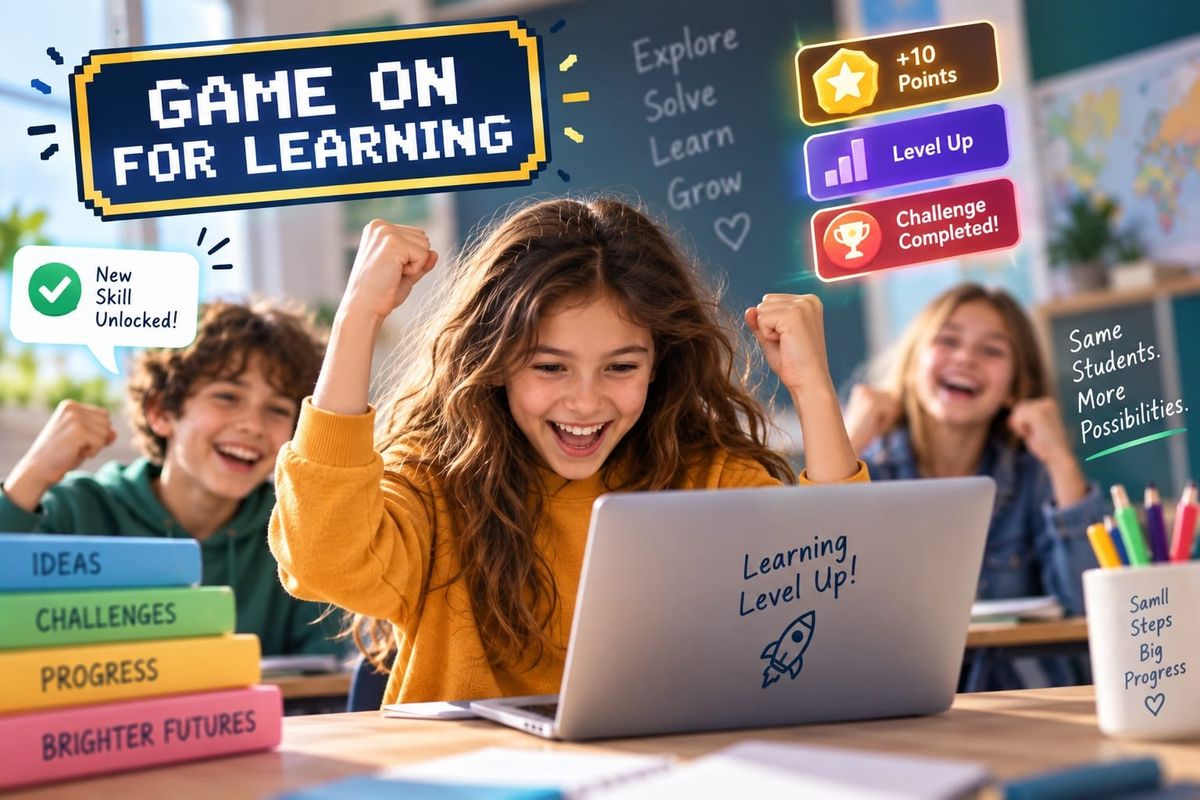
Points. Badges. Leaderboards. Streaks. Levels. Challenges.
Gamification has become so common in educational technology that it's easy to skip the obvious question:
Does any of it actually help students learn?
Recent research gives a surprisingly encouraging answer.
Yes — gamification can improve both learning and motivation.
But simply adding points to an activity doesn't magically make it better. What seems to matter is how the game elements change what students actually do.
The short version
Here's what recent research suggests:
- Gamification can improve learning — a 2025 meta-analysis found a moderate positive effect overall.
- It can increase motivation too — but results vary considerably between students and settings.
- Different game elements produce different results — challenge, goals, progress and other mechanics may matter more than simply awarding points.
- Competition isn't necessary — gamification doesn't have to mean ranking students against one another.
- The learning activity underneath still matters — game mechanics can't compensate indefinitely for a weak task.
- Start with the behavior, not the badge — decide what you want students to do differently before deciding how to gamify it.
1. Gamification can improve learning
One of the most useful recent studies is a 2025 meta-analysis of 37 randomized or quasi-randomized trials, combining 182 effect sizes.
The researchers found a medium positive effect of gamified learning on learning outcomes.
That's important.
Gamification is often discussed primarily as a way to make lessons more engaging. But this research suggests its effects aren't limited to whether students enjoy an activity.
Under the right conditions, students can actually learn more.
A separate meta-analysis covering 32 studies in higher education reached a similar conclusion. Gamified learning had a moderate positive effect overall, with particularly promising results for cognitive and skill-based outcomes.
So there's reasonable evidence that gamification can be more than decoration.
But there's an important word in that sentence:
can.
Read the 2025 meta-analysis of gamified learning outcomes
Read the meta-analysis of gamified learning in higher education
2. It can increase motivation too
Another 2025 meta-analysis focused specifically on student motivation in K–12 education.
Researchers screened 279 articles and ultimately included 31 experimental or quasi-experimental studies.
Overall, gamification had a positive effect on motivation.
Interestingly, the effect was stronger for secondary and high-school students than for primary-school students.
But there's another important detail in the results:
the effects varied substantially across studies.
Some gamified activities appear to work extremely well.
Others make much less difference.
That's a useful warning against treating “gamification” as a single teaching method.
A cooperative challenge, a leaderboard and a personal progress bar may all be called gamification.
Psychologically, they're doing very different things.
Read the 2025 K–12 motivation meta-analysis
3. Points and badges may be too simple
When people hear gamification, they often imagine something like this:
Complete a task.
Get 10 points.
Complete another.
Earn a badge.
But recent research increasingly looks at combinations of game elements rather than asking whether gamification in general works.
The 2025 meta-analysis of 37 trials found that a combination built around rules and goals, challenge, and mystery produced particularly strong results.
Another recent meta-analysis found that different combinations worked better for different kinds of learning outcomes.
That makes intuitive sense.
A point has very little educational value by itself.
But a clearly defined challenge can give students a goal.
Progress feedback can show them how they're doing.
Levels can break a difficult activity into manageable stages.
Mystery can create curiosity.
A collaborative goal can give students a reason to help one another.
The useful part isn't necessarily the game decoration.
It's the behavior the design encourages.
4. Competition isn't necessary
Leaderboards are one of the most visible forms of gamification.
They're also one of the easiest to misuse.
For the student near the top, a leaderboard may be motivating.
For the student who is consistently near the bottom, it may communicate something very different:
You're losing. Again.
Fortunately, gamification doesn't require ranking students against one another.
A class can instead compete against:
- its previous score,
- a timer,
- a fictional challenge,
- a series of levels,
- a mystery to solve,
- or a shared class objective.
Students can also progress individually without seeing how everyone else is doing.
Sometimes the most useful game mechanic isn't competition at all.
It's visible progress.
5. A boring worksheet with points is still a boring worksheet
This may be the most important limitation.
Gamification can't rescue a weak learning activity indefinitely.
Imagine a student answering 50 repetitive questions.
Now add:
+10 points!
7-day streak!
Silver Learner badge!
The interface has become more game-like.
The underlying task hasn't necessarily become more educational.
Good gamification should support the learning process rather than distract from it.
A challenge can encourage retrieval practice.
Levels can gradually increase difficulty.
Immediate feedback can help students correct misconceptions.
A collaborative game can encourage explanation and discussion.
Those are meaningful changes.
A shower of digital confetti after every click is something else.
6. Start with the behavior, not the badge
Perhaps the most useful way to design a gamified activity is to start with a simple question:
What do I want students to do differently?
Maybe you want them to:
- practice something repeatedly,
- attempt harder questions,
- explain their reasoning,
- collaborate,
- return to material later,
- notice their own progress,
- or stay with a difficult problem longer.
Only then ask:
Could a game element encourage that behavior?
If students give up too quickly, levels or incremental challenges might help.
If they need repeated practice, visible progress could make repetition more satisfying.
If discussion matters, a team challenge may work better than an individual leaderboard.
If curiosity matters, mystery and discovery might be more useful than points.
That's a very different approach from adding badges because an app happens to support badges.
Gamification isn't magic. But it isn't just decoration either.
It's easy to dismiss gamification as gimmicky.
It's equally easy to assume that making something feel like a game automatically makes it engaging.
The research supports neither extreme.
Recent meta-analyses suggest that well-designed gamification can improve both learning outcomes and student motivation. But they also show considerable variation depending on the students, context, duration and game elements being used.
So perhaps the useful question isn't:
Should I gamify this lesson?
It's:
What would I like students to do differently — and could a game mechanic help them do it?
Challenge, feedback, progress, practice, collaboration and curiosity can all contribute to learning.
Points and badges are just tools for getting there.
Don't gamify the worksheet. Gamify the learning.
Sources
Dai, W.-A., Xu, W. & Xing, Q.-W. (2025). Gamified learning impact: a meta-analysis of game element combinations on students' learning outcomes. Educational Technology Research and Development.
Read the study
Kurnaz, M. F. & Koçtürk, N. (2025). A Meta-Analysis of Gamification's Impact on Student Motivation in K–12 Education. Psychology in the Schools.
Read the study
The impact of different combinations of game elements for gamified learning in higher education on student learning outcomes (2025). Studies in Higher Education.
Read the study