Does Online Teacher Training Actually Work? What 102 Studies Found
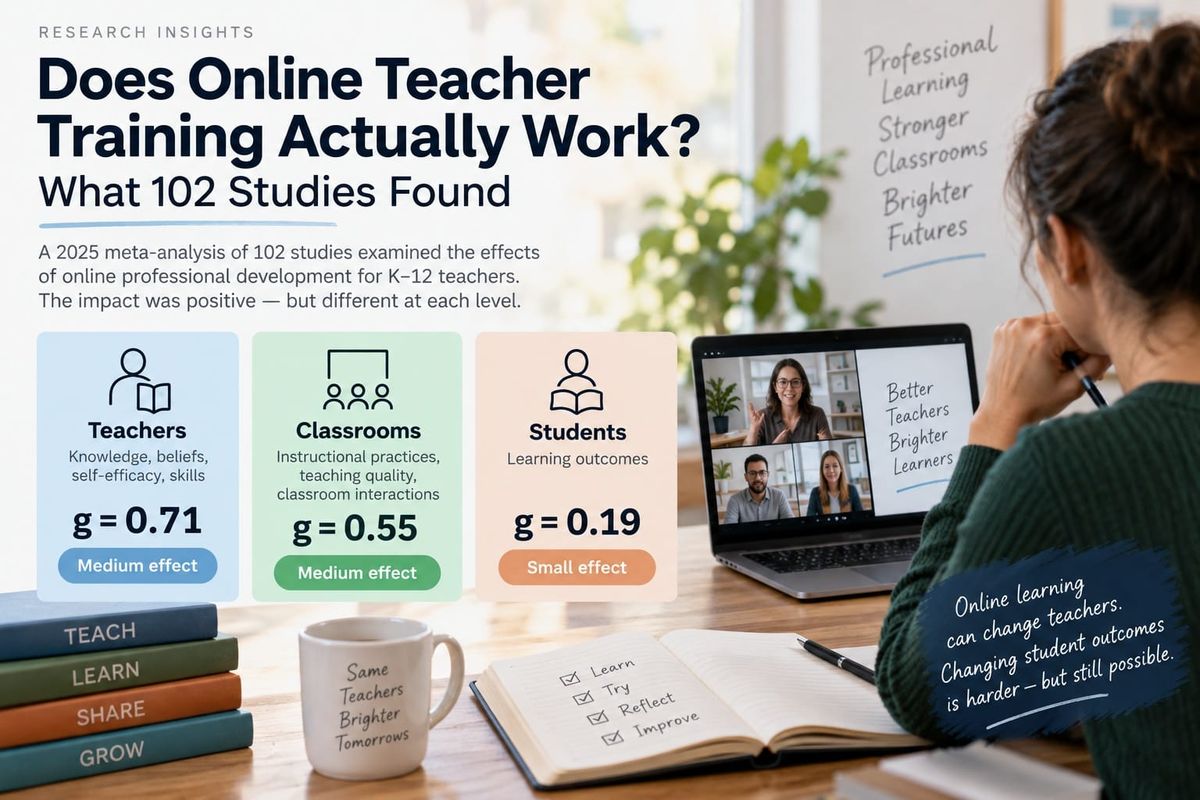
A 2025 meta-analysis of 102 studies found that online professional development can meaningfully improve teacher knowledge and classroom practice, but the effect on students is much smaller.
Online professional development is everywhere.
Webinars.
Self-paced courses.
Recorded workshops.
Virtual coaching.
Professional learning communities.
But does any of it actually change teaching?
And more importantly:
Does it improve student learning?
A 2025 meta-analysis looked at 102 quantitative studies of online professional development for in-service teachers from Grades 1–12.
The researchers examined outcomes at three different levels:
- what teachers learned
- what changed in the classroom
- what happened to students
The result was encouraging, but also revealing.
Online professional development had:
- a medium effect on teacher-level outcomes
- a medium effect on classroom-level outcomes
- only a small effect on student-level outcomes
In other words:
Teachers can learn a lot online. Changing student outcomes is much harder.
Read the full open-access study
The short version
The meta-analysis found:
- 102 studies
- teacher-level effect: g = 0.71
- classroom-level effect: g = 0.55
- student-level effect: g = 0.19
- collaborative participation was linked to stronger classroom-level effects
- synchronous online PD was associated with stronger student-level effects than asynchronous formats
- study design mattered, with weaker effects generally appearing in more rigorous controlled studies
The most useful takeaway is:
Online PD seems quite good at changing teachers. The challenge is turning that change into better learning for students.
What counts as online professional development?
The studies included a wide range of formats.
Online professional development could include:
- live webinars
- self-paced courses
- online coaching
- virtual communities
- video-based reflection
- online workshops
- collaborative learning platforms
- structured digital courses
The common factor was that teachers were learning professionally through online or digitally mediated formats.
The studies involved practicing teachers from Grades 1 through 12.
Teachers themselves showed the biggest gains
At the teacher level, the average effect was:
g = 0.71
That is a meaningful effect.
Teacher-level outcomes included things such as:
- knowledge
- beliefs
- self-efficacy
- pedagogical understanding
- confidence
- professional skills
This suggests that online professional development can be quite effective at helping teachers learn new ideas and approaches.
That matters because online PD has several practical advantages.
It can be:
- easier to access
- more flexible
- cheaper to scale
- available across large geographic areas
- easier to repeat or revisit
The question has often been whether that convenience comes at the cost of quality.
This meta-analysis suggests that, at least for teacher-level outcomes, online learning can work quite well.
Classroom practice improved too
The average effect on classroom-level outcomes was:
g = 0.55
That means the impact was not limited to what teachers knew or believed.
Some of what teachers learned online actually changed what happened in classrooms.
Classroom-level outcomes included things such as:
- instructional practices
- teaching quality
- classroom interactions
- use of new strategies
- implementation of new methods
This is an important step.
Professional development is not very useful if teachers leave a course feeling inspired but teach exactly the same way afterwards.
The evidence suggests that online PD can influence actual teaching practice.
Student outcomes improved much less
At the student level, the average effect was:
g = 0.19
That is positive.
But it is much smaller than the effects observed for teachers and classrooms.
This makes intuitive sense.
Professional development has to travel through several steps:
Teacher learns something
↓
Teacher changes practice
↓
Students experience the change
↓
Students learn more
At each step, some of the effect may be lost.
A teacher can understand a new strategy without using it consistently.
A teacher can use it well, but only in some lessons.
Students may respond differently.
School context may interfere.
Other factors may overwhelm the intervention.
So the shrinking effect is not especially surprising.
But it is important.
It reminds us that:
Teacher learning is not automatically student learning.
Collaboration mattered
One of the clearest moderator findings involved collective participation.
Online professional development had stronger effects on classroom practice when teachers participated collaboratively.
That could mean:
- discussing ideas with colleagues
- planning together
- sharing classroom experiences
- reflecting on practice
- solving problems as a group
This is interesting because online PD is often designed as an individual experience.
Watch the module.
Complete the quiz.
Download the certificate.
Done.
The meta-analysis suggests that professional learning may be stronger when teachers are not learning alone.
The social part still matters.
Live online learning may have an advantage
At the student level, asynchronous online professional development produced significantly smaller effects than synchronous formats.
That means programs involving live interaction tended to be associated with stronger student outcomes than programs teachers completed entirely on their own schedule.
Again, that does not mean asynchronous PD is ineffective.
It may simply lack some useful ingredients:
- immediate discussion
- live feedback
- accountability
- interaction
- opportunities to ask questions
The finding fits with the collaboration result.
Online professional development may work best when it still feels like professional learning with other people.
But stronger studies found smaller effects
There is another important caveat.
Studies using a control-group design reported significantly smaller effects on teacher-level outcomes than studies using only within-subject comparisons.
That matters because weaker study designs can sometimes make interventions look more effective than they really are.
For example:
If teachers improve after completing a course, that does not necessarily prove the course caused the improvement.
A control group gives us a stronger comparison.
So although the overall results are positive, the effect sizes should not be treated as perfect estimates of what every online PD program will achieve.
Not all online PD is the same
This may be the biggest practical point.
“Online professional development” is not one intervention.
A one-hour recorded webinar is very different from:
- a six-week collaborative course
- coaching with classroom feedback
- a professional learning community
- guided lesson planning
- live workshops with follow-up
Putting all of them under the same label can hide important differences.
The researchers tried to examine quality characteristics, including commonly cited features of effective professional development.
Some of these features mattered more than others.
The clearest signal was that collective participation helped classroom outcomes.
That suggests the design of the learning experience matters at least as much as whether it happens online.
Certificates are not the outcome
Online PD platforms often emphasize completion.
Modules finished.
Hours logged.
Certificates earned.
But none of those measures tells us whether teaching improved.
This meta-analysis suggests a better sequence of questions:
Did the teacher learn something?
Did classroom practice change?
Did students benefit?
Those are three different outcomes.
And they become harder to influence as we move down the chain.
What might good online teacher PD look like?
Based on these findings, a strong program probably should not consist only of content delivery.
It might include:
- live discussion
- collaboration with colleagues
- opportunities to apply ideas
- examples from real classrooms
- feedback on implementation
- follow-up after teachers try something
- reflection on student responses
The online format itself is not the problem.
The problem is designing professional development as if teachers simply need more information.
Teachers usually already have plenty of information.
The harder part is turning new ideas into new practice.
So does online teacher training work?
Yes, broadly speaking.
The evidence from 102 studies suggests that online professional development can produce meaningful improvements in teacher knowledge and classroom practice.
But the effects become smaller when we ask the question that ultimately matters most:
Did students learn more?
The answer there is still positive, but modest.
That does not make online PD a failure.
It makes professional development look more realistic.
Changing teachers is one step.
Changing classrooms is another.
Changing student outcomes is harder still.
And the programs most likely to succeed may be the ones that treat professional learning as something teachers do with each other, not simply something they complete online.
Source
Morina, F., Fütterer, T., Hübner, N., Zitzmann, S. & Fischer, C. (2025).
Effects of online teacher professional development on teacher-, classroom-, and student-level outcomes: A meta-analysis. Computers & Education, 228, 105247.