Does Technology Actually Improve Learning? What 28 Meta-Analyses Found
Schools and universities have spent decades adding technology to learning.
Laptops replaced notebooks.
Videos replaced some lectures.
Digital quizzes replaced paper tests.
Interactive platforms replaced static worksheets.
But there is a surprisingly important question underneath all of this:
Does adding technology actually improve learning?
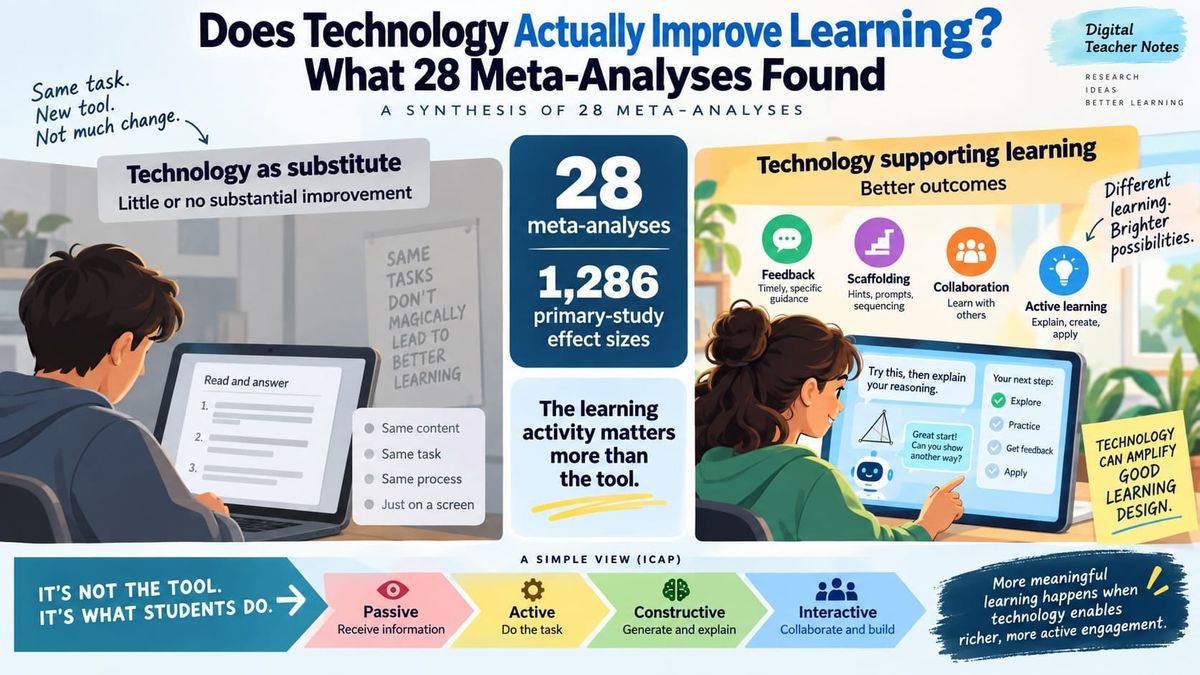
A large research synthesis tried to answer that question by looking across 28 previous meta-analyses.
Together, those meta-analyses contained 1,286 effect sizes from primary studies.
The researchers then examined 45 eligible synthesized effects and asked something more specific:
Was technology helping because it was digital, or because it changed what students were actually doing?
The answer is one of the clearest arguments against using technology simply for the sake of technology.
When digital technology merely replaced a non-digital version of the same instruction, there was no substantial improvement in students' cognitive learning outcomes.
The gains appeared when technology changed or supported the learning activity itself.
The short version
The review found that:
- 28 meta-analyses were included
- they represented 1,286 effect sizes from primary studies
- 45 synthesized effects were eligible for the second-order analysis
- replacing non-digital instruction with a digital version produced no substantial improvement on average
- learning improved when technology provided support for a specific learning activity
- technologies supporting more advanced learning activities tended to produce better outcomes
- scaffolding, feedback and sequencing are examples of the kinds of support that can make technology educationally useful
The simplest takeaway is:
Technology does not improve learning simply by being present.
What matters is what it enables students to do.
Replacing paper with a screen is not enough
Imagine two versions of the same task.
In the first, a student reads a page of text on paper.
In the second, the student reads exactly the same text on a tablet.
The delivery method has changed.
The learning activity has not.
This is what the researchers describe as a form of substitution.
Across the evidence they examined, simply replacing non-digital instruction with digital instruction produced no substantial improvement in cognitive learning outcomes.
That does not mean tablets, laptops or digital resources are useless.
It means the screen itself is not the mechanism that creates learning.
A digital worksheet is still a worksheet.
A recorded lecture can still be a lecture.
A PDF displayed on a laptop can still require exactly the same thinking as a printed page.
The interesting part is what technology changes
The results looked different when technology supported a particular cognitive process.
For example, a digital system might:
- provide immediate feedback
- scaffold a difficult task
- sequence problems based on previous responses
- help students visualize a complex process
- support collaboration
- prompt students to explain their reasoning
- adapt practice to the learner's current level
Now the technology is not simply delivering the same material through a different device.
It is changing what the learner can do.
The researchers found that these kinds of learning-activity-specific supports were associated with better cognitive outcomes.
That distinction matters.
The question is not:
“Is this digital?”
It is:
“What does the digital tool make possible that would otherwise be difficult?”
More advanced learning activities produced stronger results
The researchers also used a framework called ICAP to distinguish different levels of learner engagement.
Very roughly, learning activities can move from:
Passive
Receiving information.
Active
Doing something observable with the information.
Constructive
Generating something beyond what was directly presented.
Interactive
Building understanding together with another person.
The theory predicts that deeper forms of engagement should generally lead to stronger learning.
The review found support for this idea.
Digital technologies that enabled more advanced learning activities tended to produce better cognitive outcomes.
This is a much more useful way to think about EdTech than counting features.
A simple tool that gets students to explain, compare, create or discuss may be more educationally powerful than an impressive platform that mainly delivers information.
Feedback is a good example
Consider a digital quiz.
Version one simply tells the student:
Wrong.
Version two tells the student:
Your answer suggests you may be confusing mass with weight. Try looking again at how gravity affects each concept.
Both are digital quizzes.
But the second one provides cognitive support.
It helps the student decide what to think about next.
That is much closer to the type of technology use the review found beneficial.
The same applies to scaffolding.
A digital tool might break a complex task into steps, provide hints only when needed, or gradually remove support as the learner becomes more capable.
The value comes from the support, not from the fact that the task happens on a screen.
Technology can also make better activities practical
There is another reason digital tools can help.
Sometimes they make a good learning activity easier to run.
Imagine asking 100 students to practice a concept and receive immediate personalized feedback.
Without technology, that may be extremely difficult.
A digital system can make it practical.
Or imagine students collaboratively building a shared explanation, categorizing evidence, or comparing ideas while working from different locations.
Again, technology changes the possibilities.
This may be where EdTech has the strongest case.
Not:
“We digitized the lesson.”
But:
“We can now run a learning activity that was previously difficult, slow or impossible.”
This does not mean every interactive tool is better
There is an important trap here.
Once we say active and interactive learning are useful, it is tempting to assume that adding more clicking, animation and interaction will automatically improve a lesson.
It will not.
A student can click constantly without thinking very deeply.
A game can be highly interactive while requiring almost no understanding.
A collaborative activity can produce a lot of discussion without much learning.
The relevant question is still cognitive:
What is the student thinking about?
Technology should support the thinking required by the learning goal.
Interaction for its own sake is no better than technology for its own sake.
The review has an important limitation
This research focused on higher education.
That matters.
The included meta-analyses covered university and college learning, not primary and secondary education as a whole.
We should therefore be cautious about treating the findings as a universal rule for every classroom and every age group.
The underlying principle is still useful for schools, but the evidence base in this particular review comes from higher education.
There is another limitation too.
The 28 meta-analyses were published between 2004 and 2023 and drew on primary studies conducted over many decades.
The technologies changed enormously during that period.
A 1990s computer-based learning system and a modern AI-powered platform are obviously not the same thing.
But that may actually make the core result more interesting.
Across very different technologies, the same question keeps returning:
What learning activity does the technology support?
A useful test before adopting another tool
This research suggests a simple way to evaluate educational technology.
Before asking:
What features does it have?
ask:
What will students actually do differently because this tool exists?
Will they:
- get better feedback?
- explain their thinking?
- practice at an appropriate level?
- collaborate more meaningfully?
- visualize something difficult to understand?
- create something that requires them to reorganize knowledge?
- receive support exactly when they need it?
If the answer is simply:
“They will do the same activity, but on a screen,”
the technology may add convenience.
It may save paper.
It may improve administration.
Those can still be worthwhile benefits.
But we should not automatically expect better learning.
Perhaps “Does EdTech work?” is the wrong question
This may be the biggest lesson from the review.
Educational technology is too broad a category to ask whether it works.
A calculator, simulation, video, AI tutor, collaborative board and digital textbook are all “technology.”
They do completely different things.
A more useful question is:
What learning process does this particular technology support?
That shifts attention away from devices and platforms and back toward learning.
And perhaps that is exactly where EdTech discussions should start.
Not with the tool.
With the activity.
Source
Sailer, M., Maier, R., Berger, S., Kastorff, T. & Stegmann, K. (2024).
Learning activities in technology-enhanced learning: A systematic review of meta-analyses and second-order meta-analysis in higher education. Learning and Individual Differences, 112.