Google Is Giving Schools a Strange Choice: AI Search or No Search
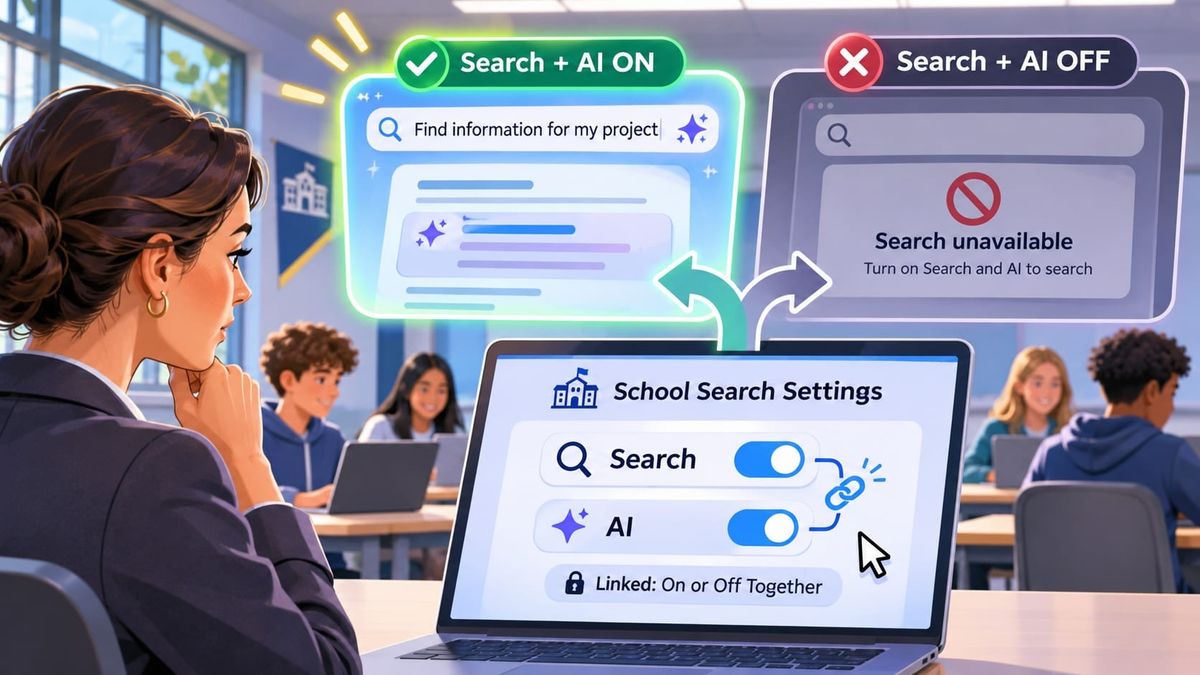
Google is giving schools more control over student AI access, but with a catch: districts that turn AI off will also lose Google Search for student accounts.
For years, “Google it” has been one of the most basic instructions in a classroom.
That is about to become more complicated.
Google has announced new controls for K–12 student accounts.
Schools will be able to decide whether students can use:
- Gemini
- Google Search
- both
- neither
That sounds like more control.
But there is an important catch.
Schools will not be able to offer students traditional Google Search without AI.
If a school decides that students should not have access to AI, it will also have to switch off Google Search.
That creates a surprisingly difficult choice.
Search and AI are now effectively tied together
Google says AI is now deeply integrated into Search.
For student accounts, it is building a special version that uses Guided Learning.
Instead of immediately giving students a final answer, Search may:
- break a problem into steps
- ask questions
- prompt students to think
- explain concepts gradually
For example, if a student pastes in a physics problem, Google says Search could guide them through the reasoning rather than simply provide the solution.
That sounds more educational than a normal AI answer.
But schools cannot choose:
Google Search, without AI.
That option will not exist.
Schools that ban AI could lose Search
This is where the policy becomes controversial.
Some large districts have recently restricted student-facing generative AI.
New York City has limited it for younger students.
Los Angeles has introduced a temporary moratorium on many generative-AI tools.
Those districts also rely heavily on Google products.
Under the new model, a district that says:
“We don’t want AI available to students.”
would also need to say:
“We don’t want Google Search available to students.”
Google says that is simply the consequence of how closely AI and Search are now integrated.
Critics see it differently.
Educators say traditional Search is still a learning tool
Searching the web is not only about finding an answer.
Students also learn to:
- choose search terms
- compare sources
- open multiple websites
- judge credibility
- distinguish primary and secondary sources
- decide which information is relevant
Those are important information-literacy skills.
Yvette Renteria of Common Sense Media told Education Week that removing traditional Search could eliminate opportunities for students to practise that kind of critical evaluation.
And this is where the issue becomes bigger than AI.
If Search starts answering the question itself, students may have fewer reasons to inspect the sources behind the answer.
Google says Guided Learning is designed to avoid shortcuts
Google is aware of that problem.
Its new Guided Learning approach is explicitly designed around what the company calls productive struggle.
The idea is that students should receive enough help to keep moving without having the thinking done for them.
Google says Guided Learning will:
- ask open-ended questions
- break down difficult tasks
- encourage reasoning
- connect to class materials
- help teachers see where students are struggling
Guided Learning is already rolling out globally inside Google Classroom.
A version for Google Search will be piloted in selected U.S. schools this month.
Read more about Guided Learning
But independent testing has raised concerns
Not everyone is convinced.
Common Sense Media previously tested Google Search’s AI features with school-style questions.
Its researchers reported that Google’s AI Mode provided full answers to all 180 homework assignments they tested.
The organization gave Google Search’s AI features its lowest safety rating for young users.
Google argues that the new school-specific Guided Learning experience is designed specifically to address that problem.
That makes the coming school pilots important.
The question is no longer:
Can Google Search answer homework questions?
Clearly it can.
The question is:
Can it help without doing too much of the thinking?
More control, but fewer choices
There is an irony in Google’s announcement.
The company says schools asked for more control.
And technically, they are getting it.
Administrators will be able to decide which age groups can use:
- Gemini
- Search
- Guided Learning
They can configure different policies for different grades.
But one option that many schools might prefer is missing:
ordinary Search with AI turned off.
Common Sense Media describes that as arguably the best option for some schools.
Google says it does not currently plan to offer it.
Smaller districts may face the biggest problem
Large school systems may be able to build technical workarounds.
For example, some districts are testing browser extensions that hide AI-generated summaries.
Commercial filtering companies can also block certain AI features.
Smaller schools may not have:
- dedicated IT staff
- custom browser tools
- money for additional filtering products
That means Google’s product decision could create a strange inequality.
A well-resourced district may be able to reconstruct traditional Search.
A small school may simply have to choose between:
Search + AI
or
no Search at all.
Search itself is changing
This story is not only about schools.
It reflects a much bigger change in how the internet works.
Traditional search was:
Question → links → investigate
AI search increasingly becomes:
Question → synthesized answer
For adults, that may be convenient.
For students learning how to research, it is more complicated.
The process of searching is itself an educational activity.
Students need to learn that information comes from somewhere.
That sources disagree.
That a confident answer can still be wrong.
That sometimes the useful skill is not getting an answer quickly.
It is knowing how to find one.
The bigger question
Google is trying to make AI Search more educational.
That could work.
Guided Learning may turn out to be considerably better for students than unrestricted AI answers.
But schools are now being asked to accept something much larger:
AI is no longer an optional feature of Search.
It is becoming part of what Search is.
That means schools may soon have to decide whether teaching students how to search the web also means teaching them how to search with AI.
And perhaps the strangest part is that the old alternative may simply disappear.
Sources
Google: Designing responsible AI for learning
Education Week: Google’s New Rules Hand Schools Hard Choices About AI and Search