Three Study Strategies Actually Work in Real Classrooms. Here’s the Catch
A new meta-analysis of 53 real classroom studies found that retrieval, spacing and interleaving all improve learning. But each works only when the practice creates the right kind of thinking.
Some learning strategies sound almost too simple.
Test yourself instead of rereading.
Spread practice over time.
Mix different kinds of problems instead of doing one type at a time.
These ideas have been supported by decades of research.
But much of that research came from laboratories or university students.
A new 2026 meta-analysis asked a much more practical question:
Do these strategies still work in real primary and secondary classrooms?
The researchers combined:
- 53 studies
- 233 effect sizes
- 7,303 students
They examined three well-known approaches:
- retrieval practice
- distributed practice
- interleaved practice
All three produced positive average effects.
But the more interesting finding was that none of them worked equally well in every situation.
The strategy mattered.
The way it was used mattered just as much.
Read the full open-access study
The short version
The researchers found:
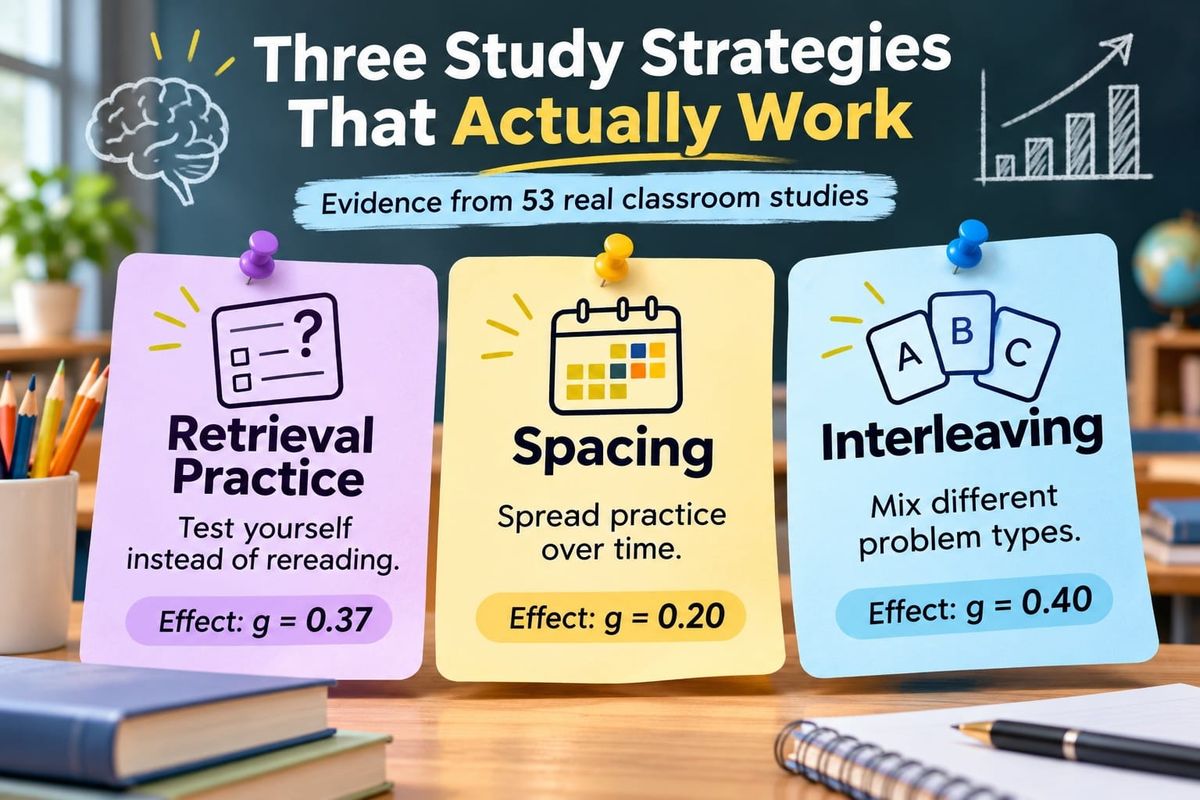
- retrieval practice: g = 0.37
- spacing: g = 0.20
- interleaving: g = 0.40
So all three improved learning on average.
But the effects depended on factors such as:
- what students were learning
- how they were tested
- whether practice matched the final task
- how long practice was spaced
- when feedback was provided
The researchers’ broader conclusion is especially useful:
These strategies work when they trigger the right kind of thinking during practice.
Not simply because a teacher has technically “used retrieval” or “used spacing.”
1. Retrieval practice worked
Retrieval practice means trying to recall information from memory instead of simply looking at it again.
For example:
Instead of rereading a definition:
Photosynthesis is the process...
the student closes the book and tries to answer:
What is photosynthesis?
The average retrieval-practice effect in authentic classrooms was:
g = 0.37
That is a meaningful improvement.
The researchers therefore recommend retrieval practice for primary and secondary classrooms.
But there was an important limitation.
Retrieval worked especially reliably for factual knowledge.
For factual material, the effect was:
g = 0.53
The evidence was much less reliable for:
- conceptual knowledge
- procedural knowledge
- comprehension
- transfer to new situations
That does not mean retrieval is useless for deeper learning.
It means simple recall practice may not be enough.
Remembering is not the same as understanding
Imagine students are learning Newton’s laws.
A retrieval question such as:
State Newton’s second law.
can strengthen memory for the rule.
But if the final assessment asks:
Explain what happens when the mass doubles while force stays constant.
the student needs more than recall.
They need to build and apply a mental model.
The meta-analysis found that retrieval effects were weaker when the thinking required during practice did not match the thinking required later.
This is sometimes called transfer-appropriate processing.
The practical version is much simpler:
Practise the kind of thinking you want students to perform later.
If the goal is remembering a fact, recall it.
If the goal is explaining, practise explaining.
If the goal is applying a concept, practise applying it.
A flashcard cannot do every job.
Retrieval worked better when practice and test matched
The study also found that test format mattered.
Retrieval practice produced positive effects for:
- recognition: g = 0.37
- cued recall: g = 0.48
- free recall: g = 0.80
The free-recall estimate was based on only nine effect sizes, so it should be interpreted cautiously.
But the broader pattern is useful.
When students practise retrieving information in a way similar to how they will later need to retrieve it, the benefit tends to be stronger.
That means a classroom full of multiple-choice quizzes may not fully prepare students for an exam requiring long explanations.
The retrieval itself should resemble the eventual learning demand.
2. Spacing worked too
The second strategy was distributed practice, usually called spacing.
Instead of doing all practice in one session:
Monday: 30 minutes
students might spread the same practice out:
Monday: 10 minutes
Wednesday: 10 minutes
Friday: 10 minutes
The average spacing effect was:
g = 0.20
Smaller than retrieval or interleaving.
But still positive.
And because spacing usually requires very little additional classroom time, even a modest effect can be useful.
The same amount of practice is simply arranged differently.
More spacing is not automatically better
This is one of the more interesting findings.
Spacing worked when distributed practice was compared with massed practice:
g = 0.39
But the researchers did not find a reliable advantage when one spaced schedule was simply compared with another slightly less-spaced schedule.
That means the lesson is not:
Wait as long as possible between practice sessions.
There seems to be a useful range.
Wait too little, and the material is still easy.
Wait too long, and students may have forgotten so much that successful retrieval becomes difficult.
The useful difficulty lies somewhere between:
too easy
and
too hard.
The spacing interval should relate to how long students need to remember
The researchers explored the relationship between:
- the gap between practice sessions
- the time until students needed to remember the material
Their tentative recommendation is interesting.
A useful practice interval may be around 10% to 100% of the expected retention interval.
For example, if students need to remember something for roughly ten days, spacing practice around one to ten days apart may make sense.
The authors stress that this is still a tentative guideline, not a classroom formula.
But the general principle is stronger:
Spacing should be long enough to require effortful retrieval, but not so long that retrieval becomes impossible.
3. Interleaving produced the largest average effect
Interleaving means mixing related problem types instead of practising them in blocks.
Blocked maths practice might look like:
AAAAAA
BBBBBB
CCCCCC
Interleaved practice might look like:
ABCBCACAB
Students must first identify which kind of problem they are looking at.
Then decide which method to use.
The average effect was:
g = 0.40
That was the largest of the three average effects in this review, although the differences between the strategies should not be treated as a competition.
Interleaving appears especially useful because it forces students to distinguish between similar concepts or procedures.
Why blocked practice can feel better
Blocked practice often feels easier.
Do ten problems using the same formula and the student quickly learns:
I know what method I am supposed to use.
That creates smooth performance.
But the student may be learning the procedure without learning when to choose it.
Interleaving removes that clue.
Now the student has to ask:
What kind of problem is this?
Which strategy applies here?
That extra decision is part of the learning.
It makes practice harder.
But potentially more useful.
The feedback result was surprising
The most interesting interleaving finding involved feedback.
Interleaved practice showed a positive effect when students received:
no feedback: g = 0.25
and an especially large effect with:
delayed feedback: g = 0.82
But the delayed-feedback result came from only five effect sizes, so it should not be treated as a firm rule.
Most surprising:
The effect was not significant when immediate feedback was provided.
At first that sounds wrong.
Immediate feedback is usually considered helpful.
Why would it weaken interleaving?
Immediate feedback can sometimes remove the useful difficulty
The authors offer a plausible explanation.
Interleaving works partly because students need to pay attention to the differences between categories and retrieve the correct method themselves.
Imagine a maths problem.
The student has to decide:
Is this multiplication, division, ratio, or proportion?
If software immediately tells them after every attempt:
Correct. This was a ratio problem.
the student gets information before they have had much opportunity to compare and distinguish the problem types.
Immediate feedback may sometimes reduce the very cognitive work interleaving was designed to create.
That does not mean teachers should stop giving feedback.
It means feedback timing can interact with the learning strategy.
Sometimes students benefit from struggling with the distinction briefly before being told the answer.
“Desirable difficulty” does not mean make learning difficult
Retrieval, spacing and interleaving are often described as desirable difficulties.
That phrase can be misleading.
The goal is not:
Make learning harder.
The idea is:
Introduce a difficulty that forces useful mental processing.
Retrieval creates effort because students have to remember.
Spacing creates effort because some forgetting has occurred.
Interleaving creates effort because students have to identify the right method.
But difficulty becomes desirable only if students can still succeed.
If they cannot retrieve anything, spacing has gone too far.
If they never understood the material in the first place, retrieval practice may simply rehearse confusion.
If interleaved problems are completely unrelated, the comparison may not teach anything useful.
There is a sweet spot.
Initial teaching still matters
This is especially important for complex knowledge.
The researchers argue that students need a sufficiently strong mental representation before retrieval practice can effectively strengthen it.
In plain English:
Students need to understand something before repeatedly trying to remember it.
That sounds obvious.
But it is easy to skip.
Retrieval practice is not a replacement for explanation.
Spacing is not a replacement for initial instruction.
Interleaving is not a replacement for showing students how different methods work.
The strategies strengthen learning after students have something worth practising.
Students often prefer the worse strategy
There is another reason these strategies matter.
Students do not always choose them naturally.
Rereading feels productive because the material looks familiar.
Blocked practice feels productive because students become fast.
Cramming feels productive because performance improves quickly.
Retrieval, spacing and interleaving often feel harder.
Students may therefore interpret them as less effective.
The research suggests the opposite.
What feels easy during practice is not necessarily what produces the best long-term learning.
What could this look like in a classroom?
You do not need a new platform.
You do not need a complicated learning system.
Retrieval
Start a lesson with three questions from last week.
No notes.
No grade.
Just retrieve.
Spacing
Bring important ideas back repeatedly over several weeks instead of finishing a unit and never mentioning it again.
Interleaving
Mix previously learned problem types so students must decide which method applies.
Instead of:
Ten problems using today's method.
try:
Four new problems mixed with four older problem types.
These are small changes.
That is part of what makes the findings useful.
But don't turn the strategies into recipes
This is probably the central message of the paper.
It would be easy to turn the results into:
Always test.
Always space.
Always interleave.
That is not what the meta-analysis says.
The effects depended on context.
The researchers repeatedly come back to the same principle:
The underlying cognitive process must actually happen.
Retrieval helps when students genuinely retrieve.
Spacing helps when the delay creates useful retrieval effort.
Interleaving helps when students genuinely compare and discriminate between problem types.
Simply arranging a worksheet to look “interleaved” is not enough.
The biggest takeaway
This study is unusually useful because it moves three famous learning strategies out of the laboratory and into real school classrooms.
Across 53 studies involving more than 7,000 students:
Retrieval worked.
Spacing worked.
Interleaving worked.
But not automatically.
The best question is therefore not:
“Which study strategy should I use?”
It is:
“What kind of thinking does this strategy force the student to do?”
If that thinking matches the learning goal, the strategy can be powerful.
If it does not, the label matters very little.
Source
Ruitenburg, S. K., Goos, M., Lambert, G., Kirschner, P. A., Jarodzka, H. et al. (2026).
A Meta-Analysis of the Effectiveness and Boundary Conditions of Retrieval Practice, Distributed Practice, and Interleaved Practice in Authentic School Classrooms. Educational Psychology Review, 38, 137.