Students Taught a Rat to Drive. The Lesson Wasn’t Really About Driving
A classroom spent five months teaching a rat named Ghost to drive a tiny car. The real lesson was persistence, problem-solving, and what to do when the first idea fails.
Some classroom projects begin with a worksheet.
This one began with a rat.
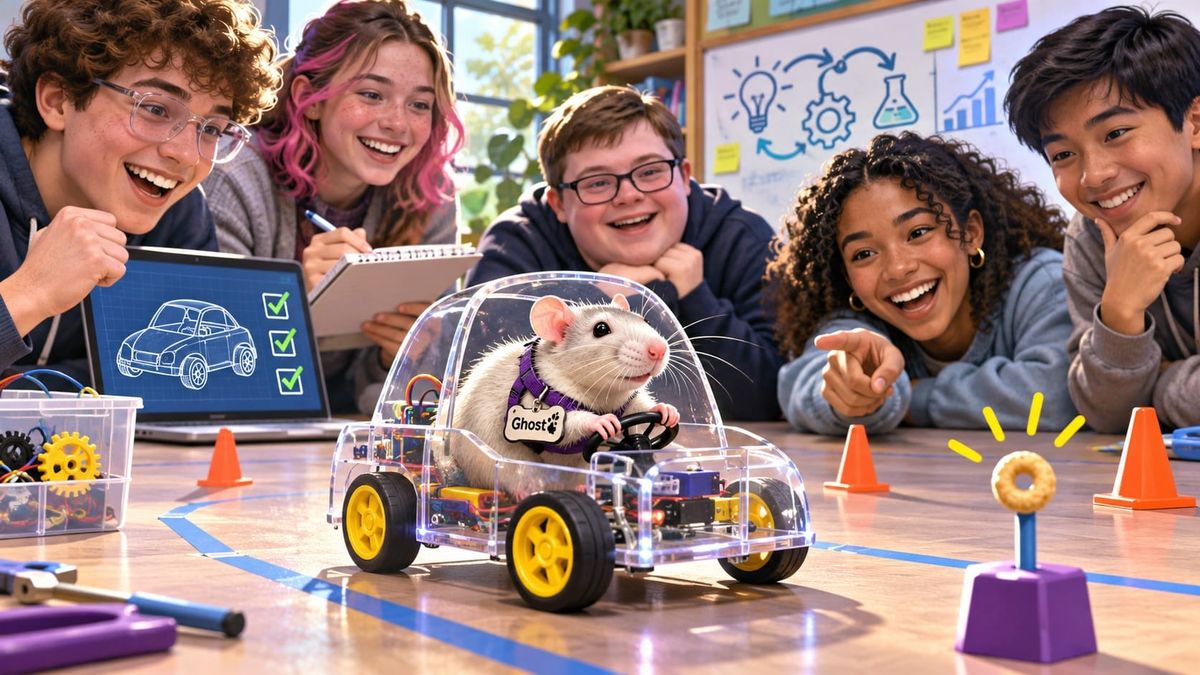
Students at the Richard A. Desrochers Educational Center in New York have spent the past five months teaching a pet rat named Ghost to drive a tiny customized car.
Yes, actually drive.
Ghost can steer toward a target, stop when he reaches it, navigate mazes, and is now learning to play miniature basketball.
But the project was never really about creating the world’s smallest driver.
It was about teaching students something much harder:
How do you solve a problem when the first idea does not work?
Read the original Times Union story
It started with a television story
The students saw a news report about researchers teaching rats to drive.
They immediately wanted to try it themselves.
Their teacher, Colleen Mahar, agreed.
She bought a one-month-old rat and ordered a kit for a small rat-controlled vehicle.
The car is essentially an open transparent box with controls Ghost can operate.
Then the real work began.
Teaching a rat is apparently quite difficult
Ghost did not simply climb into the vehicle and understand what to do.
The students had to break the challenge into smaller pieces.
First:
Get Ghost comfortable with the car.
Then:
Teach him that moving the controls produces movement.
Then:
Give him a reason to move in a particular direction.
Then:
Teach him when to stop.
The students experimented with different rewards.
At first they tried pieces of Nutri-Grain bars.
There was a problem.
They crumbled.
Eventually, one student realised that a Cheerio worked much better because it could slide onto the end of a pipe cleaner.
That became Ghost’s target.
The car has a surprisingly clever stopping system
Ghost mostly steers by following the smell of the treat.
The Cheerio sits on a pipe cleaner attached to a tambourine.
Originally, Ghost would drive forward until the pipe cleaner hit the tambourine.
The sound told him he had reached the reward.
Now he has become more precise.
He moves forward, pauses to sniff, and gradually slows when the treat gets close.
That is a surprisingly sophisticated chain of learned behaviour for something that started as:
Can we make the rat move the car?
Failure became part of the lesson
According to Mahar, Ghost did not learn consistently.
Sometimes he appeared to understand something one day and forget it the next.
Sometimes students demonstrated a task repeatedly and he still did not get it.
That turned the project into a long exercise in:
- patience
- experimentation
- observation
- positive reinforcement
- changing strategy when something fails
Those are exactly the kinds of skills that are difficult to teach through explanation alone.
You can tell students:
Be persistent.
Or you can give them a rat that refuses to cooperate.
The second version may be more memorable.
The students started designing new challenges
Once Ghost could drive, the project expanded.
Other classes built mazes for him to navigate.
Now students are creating a maze large enough for Ghost to drive his car through.
They are also teaching him basketball.
So far, he can pick up a miniature ball and carry it toward the hoop.
Actually scoring remains a work in progress.
Which is probably appropriate.
The whole project is built around the idea that:
not working yet is not the same as not working.
This is project-based learning in its simplest form
The educational structure behind the project is surprisingly strong.
There is a goal:
Teach Ghost a new behaviour.
There are constraints:
Ghost has to understand what students want him to do.
There is immediate feedback:
Either he does it or he does not.
There is iteration:
Change the reward.
Change the target.
Change the sequence.
Try again.
There is collaboration:
Different students contribute ideas and take responsibility for different parts of the project.
And there is a genuine reason to care about the result.
Nobody has to ask:
Why are we learning this?
The answer is currently sitting in a tiny car.
The most useful skill may be breaking problems into pieces
Mahar says one of her main goals was helping students learn to break a large task into smaller steps.
That is an extremely transferable skill.
It applies to:
- writing an essay
- completing a project
- learning a new skill
- fixing something that is broken
- planning a trip
- preparing for an exam
- solving a difficult problem at work
“Teach a rat to drive” sounds impossible.
“Teach the rat to touch this control” sounds manageable.
Then you build from there.
That may be the most valuable part of the project.
The class has bigger ambitions now
Mahar would like to see whether Ghost could qualify for a Guinness World Record.
The students apparently have another goal.
They want him on CNN.
Considering that the whole project started because they saw another driving rat on television, that would be a rather perfect ending.
But even if Ghost never gets a world record or a television appearance, the project has already done something more interesting.
It gave students a problem that did not have a worksheet answer.
They had to observe.
Experiment.
Fail.
Adjust.
Try again.
And eventually watch a rat drive across the classroom toward a Cheerio.
Sometimes the strangest classroom project is exactly the one students remember.
Source
Times Union: Meet Ghost, a rat taught to drive by a special education classroom