Handwriting vs Typing: What Actually Helps Students Learn?
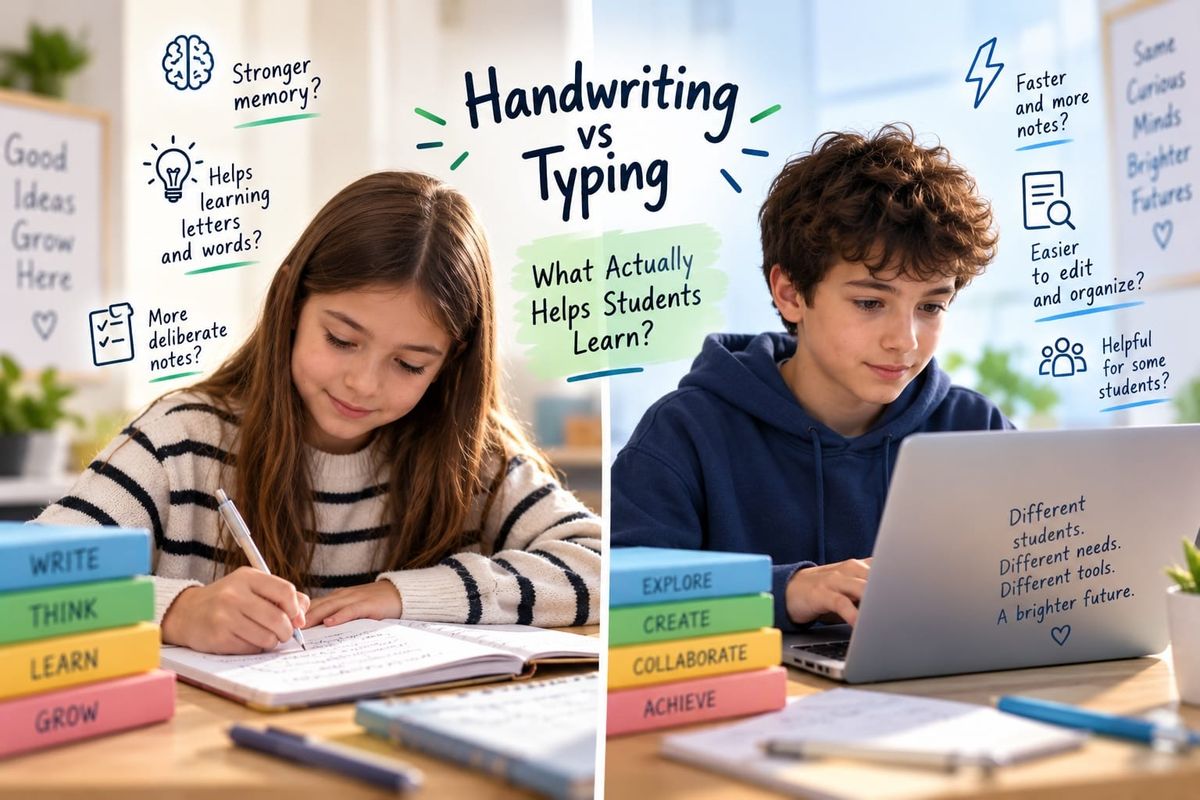
Laptops and tablets have gradually replaced notebooks in many classrooms.
It's easy to see why. Students can type faster, edit without rewriting, search their notes, collaborate with classmates and keep everything in one place.
But there's a persistent question underneath all of this:
Do students actually learn better when they write by hand?
Recent research suggests that handwriting really does have some advantages — particularly when children are learning to read and write.
But the story isn't as simple as “put away the keyboards.”
Age, the learning task and the individual student all seem to matter.
The short version
Here's what recent research suggests.
- Handwriting appears particularly important when children are learning letters and words — physically forming letters may contribute to how children learn them.
- For older students, handwriting still has some advantages — especially when taking notes for learning.
- Typing lets students capture much more information — and that's not necessarily a bad thing.
- The task matters — handwriting can outperform typing on one activity while making little difference on another.
- Typing may actually be better for some students — individual differences can change which medium works best.
- The useful question isn't pen or keyboard — it's which tool fits what students are trying to learn.
1. Handwriting appears particularly important when children are learning letters and words
One of the most interesting recent studies was published in the Journal of Experimental Child Psychology in 2025.
Researchers taught 50 prereaders unfamiliar letters and made-up words.
Some children learned them by writing by hand. Others typed them on a computer.
The children who practiced through handwriting performed better afterwards across tests involving letter naming, writing, word identification and decoding.
Why?
One possible explanation is that handwriting isn't simply another way of entering text.
To write a letter, a child has to reproduce its shape through a sequence of movements.
Typing is different. The letter already exists on the keyboard. The child identifies it and presses a key.
That additional physical process involved in handwriting — sometimes called graphomotor activity — may help children build stronger representations of letters and words.
For children who are just learning how written language works, that could be particularly important.
Read the 2025 study in the Journal of Experimental Child Psychology
2. For older students, handwriting still has some advantages
The handwriting effect doesn't necessarily disappear once students can read and write.
A large meta-analysis published in Educational Psychology Review examined 24 studies from 21 articles comparing handwritten and typed lecture notes among college students.
Students who took and reviewed handwritten notes achieved better learning outcomes overall.
The effect wasn't enormous, but it was consistent enough to be statistically meaningful.
Interestingly, typing had a very different advantage:
students typed substantially more notes.
That gives us an interesting trade-off.
Typing is excellent at capturing information.
Handwriting may be better at processing it.
Read the meta-analysis in Educational Psychology Review
3. Typing lets students capture much more information
This difference makes intuitive sense.
Most people can type faster than they can write neatly by hand.
When a teacher explains something, a student with a laptop may be able to record sentences almost word for word.
A student using a pen usually can't.
They have to decide:
What's important?
How can I shorten this?
How does this idea connect with what was said earlier?
That constraint might sometimes be useful.
The goal of taking notes isn't necessarily to produce the most complete transcript of a lesson.
It's to create something that helps you understand and remember it.
But we should be careful here.
More notes aren't inherently worse.
There are situations where having a detailed record is extremely useful, and students can process typed notes actively too.
The research doesn't tell us that keyboards prevent thinking.
It tells us that the fastest way to record information isn't automatically the best way to learn it.
4. The task matters
A particularly useful 2025 study looked at 305 students in Grades 4–7 performing school writing tasks both by hand and on a computer.
For younger students in Grades 4 and 5, handwriting produced better results during a copying task: their handwritten texts contained fewer spelling errors and were longer.
But when students completed a narrative writing task, researchers found no significant overall spelling advantage for handwriting.
Same students.
Same two technologies.
Different task.
Different result.
That's a useful reminder of how easily broad claims about technology can become misleading.
“Handwriting improves spelling” sounds like a simple conclusion.
The actual result is closer to:
Handwriting improved spelling for particular students performing a particular kind of task.
Read the 2025 Scientific Reports study
5. Typing may actually be better for some students
Here's where the story becomes even more interesting.
Another 2025 study compared handwriting and typing while middle-school students learned unfamiliar words.
For typically developing readers, researchers found learning through both handwriting and typing.
But students with developmental dyslexia showed a different pattern.
For them, typing resulted in better spelling recall and stronger semantic integration than handwriting.
That's almost the opposite of the simple advice that students should always write things down by hand if they want to remember them.
And there's a plausible reason.
If handwriting itself requires substantial effort, some of the student's cognitive resources are being spent on the mechanics of writing rather than the thing they're trying to learn.
Removing that difficulty can sometimes help.
Read the 2025 study in Learning and Instruction
There's similar nuance in recent research on note-taking and students with higher ADHD symptoms.
A 2025 study found that taking notes helped compared with taking no notes, whether those notes were handwritten or typed. The researchers concluded that the best medium may depend partly on an individual's transcription abilities.
In other words, accessibility isn't an exception to the question.
It's part of the question.
6. The useful question isn't pen or keyboard
It's tempting to turn research like this into a classroom rule:
Students should take notes by hand.
But the evidence points toward something more useful.
If young children are learning how letters and written words work, handwriting appears to have genuine benefits.
If students are taking notes primarily to understand and remember a lesson, handwriting may encourage useful processing.
If they need to capture a large amount of information quickly, typing has obvious advantages.
If the mechanics of handwriting create additional difficulty for a particular student, typing may remove a barrier to learning.
And for many ordinary writing tasks, the difference may be much smaller than we imagine.
So perhaps we shouldn't ask:
Should students use paper or computers?
Instead, we can ask:
What are students supposed to learn from this particular activity?
Sometimes the answer may point toward a keyboard.
Sometimes it may point toward a pencil.
And sometimes the best lesson may deliberately use both.
Technology doesn't have to replace the thing that came before it
There's a broader lesson here for educational technology.
When a new tool makes an old activity faster or more convenient, it's natural to assume that the old method has become obsolete.
But efficiency and learning aren't always the same thing.
Typing is faster than handwriting.
A calculator is faster than mental arithmetic.
Search is faster than remembering.
AI can be faster than all of them.
That doesn't mean the slower activity has no educational value.
Sometimes the effort involved is part of what we're trying to teach.
The challenge isn't choosing between technology and traditional methods.
It's knowing when the convenience of technology helps learning — and when removing a little convenience might actually help students think.
Sources
This article draws primarily on recent research into handwriting, typing and learning:
- Ibaibarriaga, Acha & Perea — The impact of handwriting and typing practice in children's letter and word learning (2025)
- Broc, Goudeau & Colliot — Comparing the effects of typing and handwriting on spelling performance in school (2025)
- Flanigan et al. — Typed Versus Handwritten Lecture Notes and College Student Achievement: A Meta-Analysis (2024)
- Learning by writing: The influence of handwriting and typing on novel word learning in typically developing readers and readers with dyslexia (2025)
- The Effects of Notetaking Modality and Symptoms of ADHD on Learning (2025)