Media Multitasking and Learning: What 66 Studies Actually Found
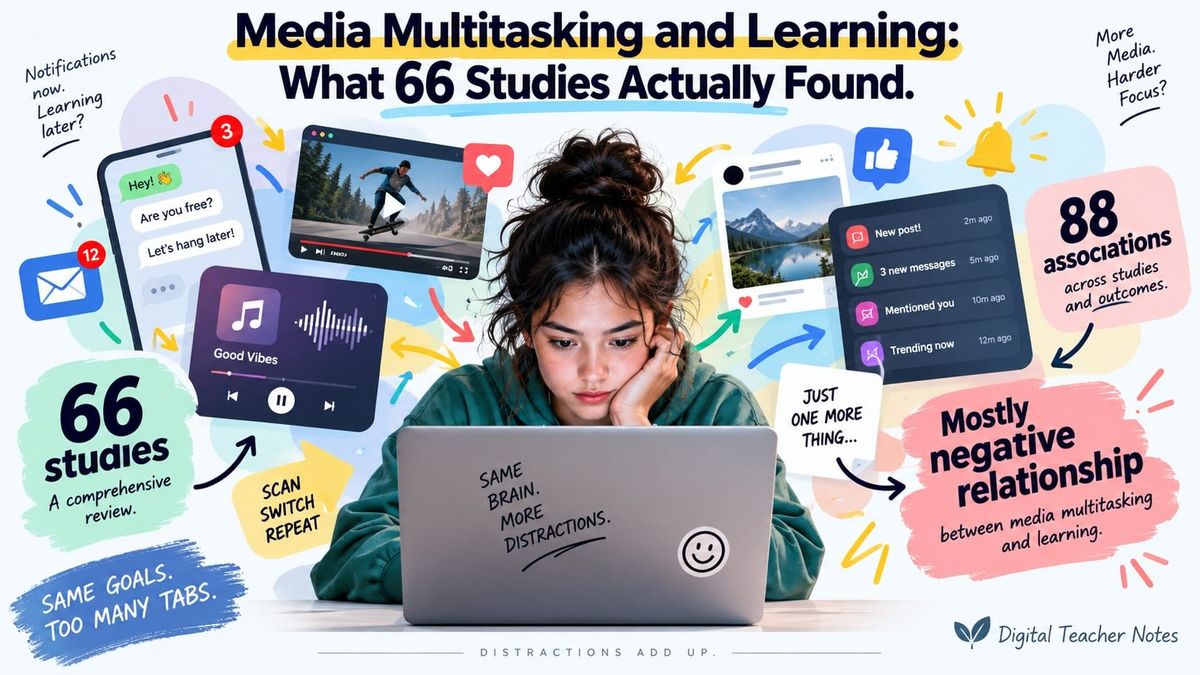
A review of 66 studies found that media multitasking is usually associated with slightly worse academic performance, but also revealed a major gap in what we know about younger students.
A student is writing an assignment.
A message appears.
They check it.
Then they return to the document.
A video is playing in another tab.
Music is running in the background.
Another notification arrives.
This kind of media multitasking has become a normal part of studying.
But does it actually matter for learning?
A recent scoping review looked across 66 studies to find out.
The researchers identified 88 different associations between media multitasking and academic achievement.
The overall pattern was clear:
Most studies found a negative relationship.
But there is an important qualification.
The effects were usually small, and most of the research was conducted with university students.
So the evidence is strong enough to raise concern, but not strong enough to justify simplistic claims such as:
“Multitasking destroys learning.”
Read the full open-access review
The short version
The review found that:
- 66 studies met the inclusion criteria
- Those studies reported 88 associations between media multitasking and academic achievement
- Most associations were negative
- Only two studies reported positive associations
- Most reported effect sizes were small
- 55 of the 66 studies focused on higher education
- Only one study focused exclusively on elementary-school children
- Most studies were correlational rather than experimental
- The evidence for younger students remains surprisingly limited
The practical takeaway is not that students must work in complete digital isolation.
It is:
Frequent switching between learning and unrelated media is unlikely to be helping.
What counts as media multitasking?
Media multitasking can mean several things.
It might involve using multiple forms of media at the same time.
For example:
Watching a lecture while messaging friends.
It can also mean using media while doing a non-media activity.
For example:
Checking social media while reading a textbook.
Or:
Responding to notifications while solving maths problems.
The important feature is not simply that several devices or apps are open.
It is that attention is moving between different activities.
66 studies, but mostly university students
The researchers searched studies published between 2010 and 2023.
They eventually included 66 studies.
But the distribution across educational levels was very uneven.
Of the 66 studies:
- 55 involved college or university students
- 1 included students spanning high school and university
- 4 focused on high-school students
- 6 included students across elementary to high-school ages
- only 1 study focused exclusively on elementary-school children
That is a major limitation.
Media multitasking is often discussed as a problem affecting children and teenagers.
But most of the research base actually comes from older students.
So we know considerably more about a university student checking messages during a lecture than we do about a 10-year-old switching between homework and YouTube.
Most studies found a negative relationship
Across the review, the predominant finding was that more media multitasking was associated with poorer academic performance.
That could mean lower:
- grades
- GPA
- test performance
- post-test scores
depending on how each study measured achievement.
Only two studies reported positive associations.
That makes the overall pattern hard to ignore.
But the review also notes that most effect sizes were small.
That matters.
Media multitasking is probably not the single factor determining whether a student succeeds or fails.
Academic achievement is influenced by many things:
prior knowledge, motivation, teaching quality, sleep, study habits, family circumstances, and much more.
Media multitasking appears to be one part of that picture.
Association does not necessarily mean cause
Another limitation is particularly important.
Most of the studies were cross-sectional and correlational.
That means researchers often measured how much students multitasked and compared that with academic performance.
If students who multitask more tend to earn lower grades, there are several possible explanations.
Perhaps multitasking makes learning less effective.
But it is also possible that students who already struggle with attention or motivation are more likely to multitask.
Or both effects could be happening at the same time.
Experimental studies can help separate these possibilities.
Interestingly, the review found that experimental studies were more likely than correlational studies to report no association.
So we should be careful about turning the overall pattern into a simple causal claim.
Why might task switching make learning harder?
Even though the review focused on academic outcomes rather than the underlying cognitive mechanisms, the basic problem makes intuitive sense.
Learning often requires keeping information active in working memory.
Imagine reading a paragraph and trying to connect it with the previous one.
Then a message appears.
Attention shifts.
The message introduces a completely different topic.
Then the student returns to the paragraph and has to reconstruct what they were thinking.
The interruption may only last a few seconds.
But the learning task has changed.
The student is no longer simply continuing where they left off.
They may need to rebuild the mental context.
Repeated enough times, those small interruptions can accumulate.
Not all multitasking is necessarily the same
There is also an important distinction between unrelated distraction and activities that are genuinely part of the same learning task.
A student might:
watch a science simulation while taking notes.
compare two sources while writing an essay.
listen to a teacher explanation while examining a diagram.
Those activities involve multiple streams of information, but they are all serving the same goal.
Compare that with:
writing an essay while checking TikTok.
watching a lecture while answering messages.
studying vocabulary while scrolling social media.
The second group repeatedly introduces unrelated information.
So the useful distinction may not be:
one screen versus several screens.
It may be:
one learning goal versus several competing goals.
Notifications may matter even before students respond
One practical issue is that distraction does not always begin when a student opens another app.
A notification itself creates a decision.
Do I check it?
Who sent it?
Is it important?
Can I ignore it?
Even when the student decides to continue working, some attention has already shifted away from the task.
This makes notifications a particularly easy target for improving the learning environment.
Students do not necessarily need extreme “digital detox” rules.
Something as simple as silencing non-essential notifications during focused work may reduce unnecessary switching.
Younger students are the big unanswered question
One of the most useful findings from this review is actually a research gap.
We still have surprisingly little evidence about media multitasking and academic achievement among younger students.
The researchers specifically highlight this limitation.
That matters because younger learners may respond differently.
They may have:
- less developed attention control
- different technology habits
- more adult supervision
- different kinds of schoolwork
- different access to personal devices
The current evidence does not justify assuming that results from university students apply perfectly to children.
That is an important point for schools.
A more realistic classroom question
It is easy to turn this research into a rule:
Phones away. One tab open. No music. No distractions.
But that is probably too simplistic.
A better question is:
How many unrelated things are competing for the student's attention while they are trying to learn?
Teachers can reduce that competition in fairly practical ways.
For example:
- give students a short period of uninterrupted work
- ask them to silence unnecessary notifications
- avoid requiring several unrelated digital tools at once
- make it clear when devices are needed and when they are not
- encourage students to finish one cognitive task before switching to another
The goal is not to eliminate technology.
It is to protect periods of focused thinking.
The interesting part is not the size of the effect
Most of the effects in this review were small.
That might make the issue sound unimportant.
But small effects can still matter when the behaviour happens repeatedly.
A single notification probably does not ruin a lesson.
A single switch to another tab probably does not ruin an assignment.
But if a student switches attention dozens or hundreds of times during a week of studying, even a modest cost may become meaningful.
The review does not show that media multitasking is catastrophic.
It shows something more believable:
It usually does not seem to help, and it often appears to make academic performance slightly worse.
That may be enough reason to design learning environments with a little less competition for attention.
Source
Lax, M., Mölsä, M. E., Korhonen, J. & Söderberg, P. (2026).
Media multitasking and academic achievement among different educational levels: a scoping review. Discover Education, 5, 29.