Not All Student Engagement Is the Same. What 62 Studies Found
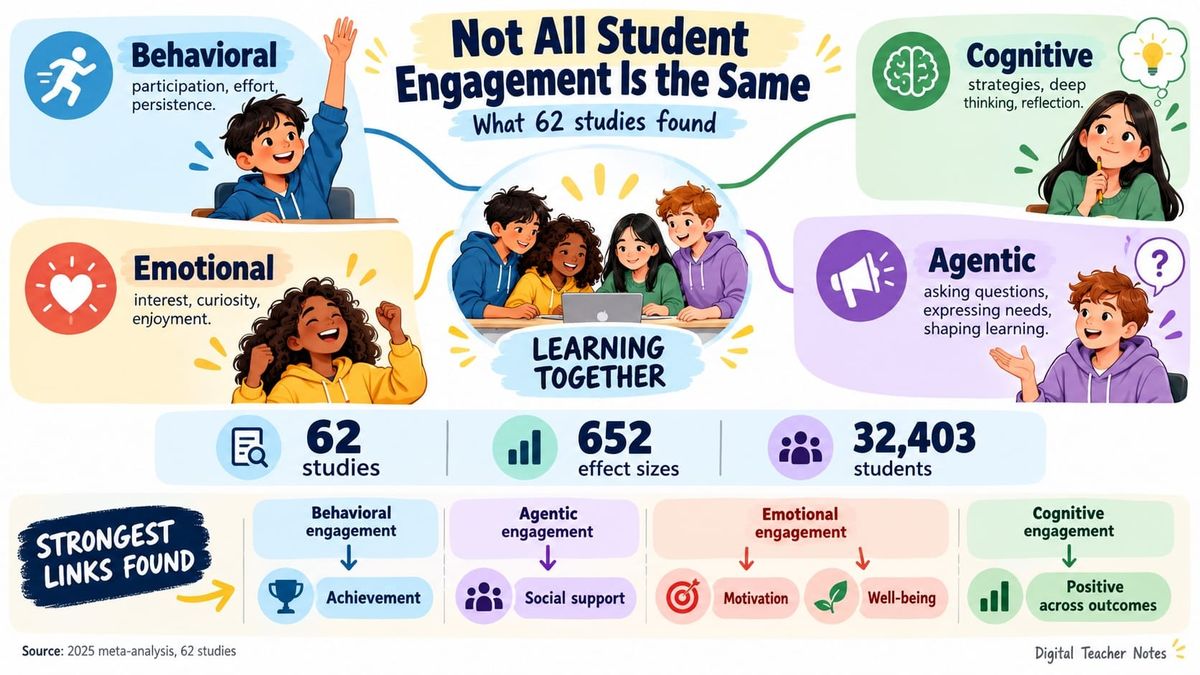
A 2025 meta-analysis of 62 studies found that different kinds of student engagement appear to serve different purposes, from achievement and motivation to social support and well-being.
“Student engagement” sounds like one thing.
A student is engaged or they are not.
But researchers increasingly treat engagement as several different processes.
A student can be:
- behaviorally engaged by paying attention, participating and persisting
- cognitively engaged by using strategies and thinking deeply
- emotionally engaged by feeling interested, curious or connected
- agentically engaged by asking questions, expressing preferences and actively shaping the learning experience
A 2025 meta-analysis asked a surprisingly useful question:
Do these different kinds of engagement serve different purposes?
The researchers combined 652 effect sizes from 62 studies involving 32,403 students.
And the answer was largely yes.
Different forms of engagement were most strongly associated with different outcomes.
Read the full open-access study
The short version
Across the 62 studies:
- behavioral engagement was most strongly associated with academic achievement
- agentic engagement was most strongly associated with social support
- emotional engagement was most strongly associated with motivation
- emotional engagement was also most strongly associated with well-being
- cognitive engagement was positively related to all four outcomes, but it did not emerge as the strongest specialized predictor for any one of them
That does not mean one type is “better” than the others.
It means engagement may work more like a system.
Different forms of engagement may contribute to different parts of the learning experience.
62 studies, 32,403 students
The researchers included studies from classroom settings spanning roughly ages 10 to 26.
The average student age was 16.8 years.
The sample was geographically balanced:
- 31 studies used Eastern, mostly Asian, samples
- 31 used Western samples from Europe, North America, South America or Africa
Every included study measured all four forms of engagement.
That matters because it allowed the researchers to compare them directly instead of looking at each one in isolation.
Behavioral engagement was most closely linked with achievement
For academic achievement, all four forms of engagement were positively related to outcomes.
But behavioral engagement showed the strongest association.
The average Fisher’s z correlations with achievement were:
- behavioral: 0.31
- cognitive: 0.28
- emotional: 0.25
- agentic: 0.24
That pattern makes intuitive sense.
Students improve when they:
- put in effort
- persist when work is difficult
- participate
- practice
- stay on task
Thinking deeply matters too.
But without effort and persistence, good intentions do not turn into much learning.
In the relative-weights analysis, behavioral engagement accounted for the largest share of the engagement-related prediction of achievement:
38.1%
So if the outcome you care about is grades, skill development or performance, observable participation and persistence appear especially important.
Agentic engagement was most closely linked with support
Agentic engagement is probably the least familiar of the four.
It describes students actively contributing to the learning environment.
For example, a student might:
- ask for clarification
- tell the teacher what they need
- express a preference
- suggest a different way to approach a task
- ask for more support
- communicate when something is not working
The meta-analysis found that agentic engagement was especially strongly associated with social support.
For pooled social support, the average associations were:
- agentic: 0.49
- emotional: 0.49
- cognitive: 0.42
- behavioral: 0.40
Agentic and emotional engagement were essentially tied at the top overall.
But in the relative-weights analysis, agentic engagement contributed the largest unique share:
35.0%
The interpretation is interesting.
Students who actively communicate their needs may be better able to recruit support from teachers.
Support is not always something a student passively receives.
Sometimes students help create the conditions in which support becomes possible.
Emotional engagement was the strongest predictor of motivation
Emotional engagement includes things such as:
- interest
- enjoyment
- curiosity
- enthusiasm
- feeling involved in the activity
For motivation, emotional engagement clearly stood out.
The average associations were:
- emotional: 0.64
- cognitive: 0.53
- behavioral: 0.52
- agentic: 0.45
And emotional engagement accounted for the largest relative contribution:
39.3%
This suggests something that may seem obvious but is easy to overlook.
Students are more likely to feel motivated when the learning experience itself generates positive emotional involvement.
That does not mean every lesson needs to be entertaining.
But motivation is not only about discipline or rewards.
How students feel while learning appears to matter substantially.
Emotional engagement was also strongest for well-being
The most striking result may be the relationship with well-being.
Only four studies measured well-being, so this part of the evidence base is much smaller.
But within those studies, emotional engagement had by far the strongest association.
The average correlations were:
- emotional: 0.84
- behavioral: 0.60
- cognitive: 0.55
- agentic: 0.53
In the relative-weights analysis, emotional engagement accounted for:
50.3%
of the engagement-related prediction of well-being.
That is a large share.
It suggests that feeling interested, connected and emotionally involved in learning may matter for much more than whether students complete the task.
It may also relate to whether the learning experience feels psychologically positive.
What about cognitive engagement?
This is where the results become slightly surprising.
Cognitive engagement sounds like the form that should matter most academically.
It includes:
- using learning strategies
- thinking deeply
- monitoring understanding
- trying to make sense of difficult material
And cognitive engagement was positively associated with all four outcomes.
For example, its association with achievement was 0.28, only slightly below behavioral engagement.
But it did not emerge as the strongest specialized predictor for any of the four outcomes.
The researchers do not conclude that cognitive engagement is unimportant.
Quite the opposite.
They suggest the finding raises questions about how cognitive engagement is currently defined and measured.
It may overlap heavily with other forms of engagement, or current questionnaires may not capture its unique role particularly well.
So the useful conclusion is not:
“Deep thinking does not matter.”
It clearly does.
The conclusion is:
The current evidence does not show a single outcome for which cognitive engagement is uniquely dominant.
Engagement is probably a feedback loop
One of the most useful ideas in the paper is that engagement and its outcomes are probably bidirectional.
For example:
A student participates more.
They improve.
Improvement increases confidence.
Confidence increases motivation.
Higher motivation makes them participate more.
Similarly:
A student asks the teacher for help.
The teacher responds supportively.
The student feels more comfortable asking questions.
That creates more support.
So we should be careful about interpreting the findings as simple one-way effects.
The studies largely show relationships, not clean causal chains.
“Engagement” may be too vague a classroom goal
Teachers often say:
“I want students to be more engaged.”
But this meta-analysis suggests a better question:
Engaged in what way, and for what purpose?
If the goal is achievement, focus on behaviors such as:
- sustained effort
- participation
- persistence
- deliberate practice
If the goal is stronger teacher-student support, create opportunities for students to:
- ask for help
- express needs
- make suggestions
- communicate preferences
If the goal is motivation or well-being, pay attention to:
- interest
- enjoyment
- curiosity
- belonging
- emotional connection
Those are different instructional problems.
They may require different solutions.
More activity is not automatically better engagement
There is also an important practical warning here.
Behavioral engagement does not simply mean:
“The student is visibly busy.”
A student can click through an app, fill out a worksheet or participate in a game without thinking much.
Likewise, emotional engagement does not mean:
“The student is having fun.”
And agentic engagement does not mean:
“The student gets to choose everything.”
The categories describe different relationships between the learner and the learning process.
The important question is whether the activity is helping students engage in the right way for the outcome you want.
A simple way to use this research
Instead of asking:
“How do I make this lesson more engaging?”
try asking:
“What kind of engagement does this lesson need?”
For example:
If students are giving up too quickly
You may need to support behavioral engagement.
Break the task into manageable steps.
Make progress visible.
Provide opportunities for successful practice.
If students rarely ask for help
You may need to support agentic engagement.
Invite questions.
Give students structured ways to communicate what they need.
Make it safe to say:
“I don’t understand this yet.”
If students understand the work but seem disconnected
You may need to support emotional engagement.
Increase relevance.
Use meaningful examples.
Give students a reason to care about the question.
If students complete tasks mechanically
You may need to support cognitive engagement.
Ask them to explain.
Compare.
Predict.
Justify.
Reflect.
The biggest takeaway
Student engagement is not one switch that teachers can simply turn on.
It has several dimensions.
And those dimensions seem to be associated with different parts of learning.
Behavioral engagement appears especially important for achievement.
Agentic engagement is closely tied to social support.
Emotional engagement appears particularly important for motivation and well-being.
Cognitive engagement matters across outcomes, even if it does not yet show one clearly specialized role.
So perhaps the most useful question is not:
“Are my students engaged?”
It is:
“How are they engaged, and is that the kind of engagement this learning goal actually needs?”
Source
Jang, H., Reeve, J. & Cheon, S. H. (2025).
Specialized Purpose of Each Type of Student Engagement: A Meta-Analysis. Educational Psychology Review.