“Pencils, Not Prompts”: Students Are Starting to Push Back on AI in School
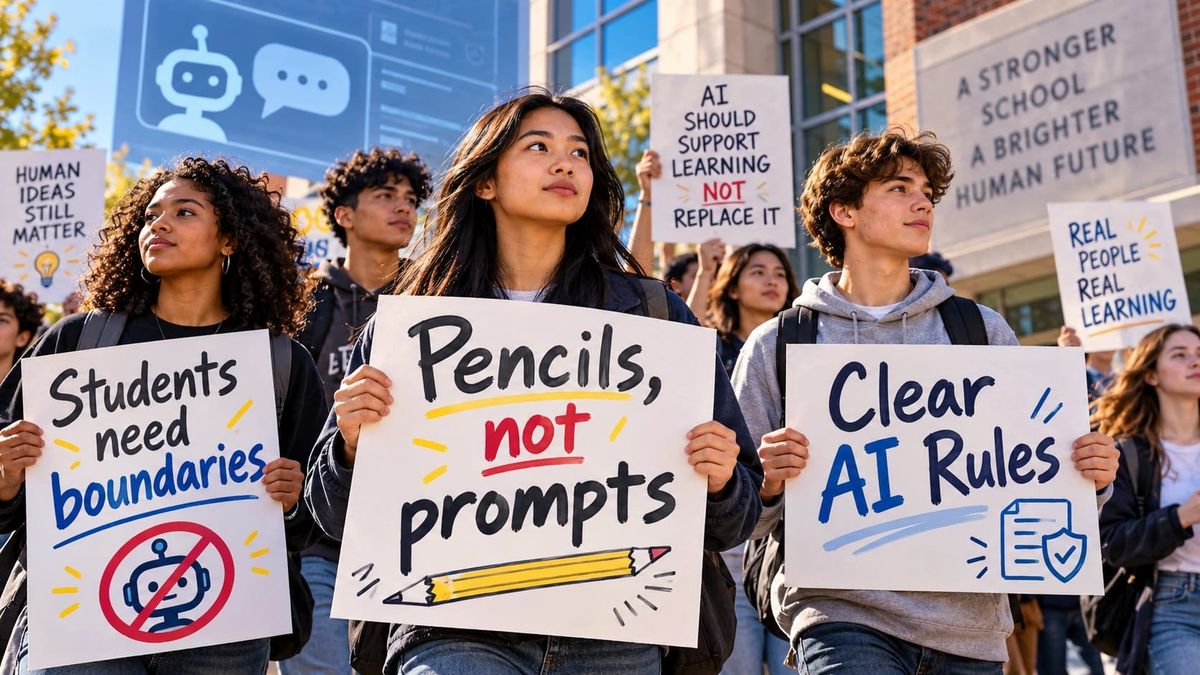
More than 100 students at a Washington high school walked out of class demanding clearer AI rules. Their slogan: “Pencils, not prompts.”
Most debates about AI in education are led by adults.
Teachers.
Parents.
School leaders.
Technology companies.
Policymakers.
But this week, something different happened.
More than 100 students at Evergreen High School in Vancouver, Washington walked out of class to demand clearer rules for how artificial intelligence should be used in school.
Their slogan was simple:
“Pencils, not prompts.”
The students were not asking the district to pretend AI does not exist.
They were asking for something more practical:
clear boundaries.
What were the students protesting?
According to local reporting, students left their sixth-period classes and gathered at a designated area on campus.
Their concern was not simply that students were using AI.
They said teachers were using it too, and that the school district had not yet created a clear policy explaining what was acceptable.
That creates obvious confusion.
If one teacher allows AI for brainstorming and another treats the same use as cheating, students are left trying to guess the rules.
If teachers themselves use AI to create materials or feedback, students may also wonder why their own use is restricted differently.
The district says it is working on an AI policy.
This is not really an anti-AI protest
The slogan sounds like one:
“Pencils, not prompts.”
But the students' demand appears more nuanced than that.
They want clear expectations about when AI is appropriate and when it is not.
That distinction matters.
There is a big difference between:
- using AI to generate an entire essay
- asking AI to explain a difficult concept
- brainstorming possible project ideas
- checking grammar
- asking for feedback on a draft
- using AI to complete homework without understanding it
Treating all of those as the same behavior is increasingly difficult.
Students are dealing with inconsistent rules
This may be one of the biggest practical problems schools face with AI.
Technology has moved faster than policy.
Students often encounter very different expectations from one classroom to another.
One teacher may encourage AI.
Another may ban it.
A third may allow it only if students disclose how they used it.
A fourth may use AI themselves while telling students not to.
Without clear school-level rules, every assignment becomes a negotiation.
That is not particularly fair to students or teachers.
The protest is interesting because students noticed the problem first-hand
Adults often talk about students as if they are simply eager to use AI for everything.
That is clearly not always true.
Some students are worried about:
- losing the opportunity to think independently
- unclear rules around cheating
- teachers relying too heavily on AI-generated material
- different expectations between classes
- not knowing what kind of AI use is considered acceptable
The Evergreen protest suggests that students may want structure just as much as teachers do.
Schools may need fewer slogans and better rules
“Ban AI” is simple.
“Use AI responsibly” is also simple.
Neither tells a student very much.
A useful school policy probably needs to answer concrete questions.
For example:
Can AI be used for brainstorming?
Can students use it to improve writing?
Can it generate first drafts?
Does AI use need to be disclosed?
Can teachers use AI-generated feedback?
Can AI be used during assessment?
Which tasks should remain completely AI-free?
Those are the questions students actually encounter.
The bigger shift
For the past two years, much of the school AI debate has focused on whether teachers will accept the technology.
That debate may be changing.
Students are now experienced enough with AI to have opinions about where it helps and where it gets in the way.
That means schools may need to involve them in writing the rules.
Not because students should decide everything.
But because they are the people living under those rules every day.
And perhaps that is the most interesting part of the Evergreen protest.
The students were not asking adults to solve AI for them.
They were asking adults to finally define the boundaries.
Sources
KGW: Evergreen High School students demand AI regulation in classrooms