Should Students Be Allowed to Use Wikipedia?
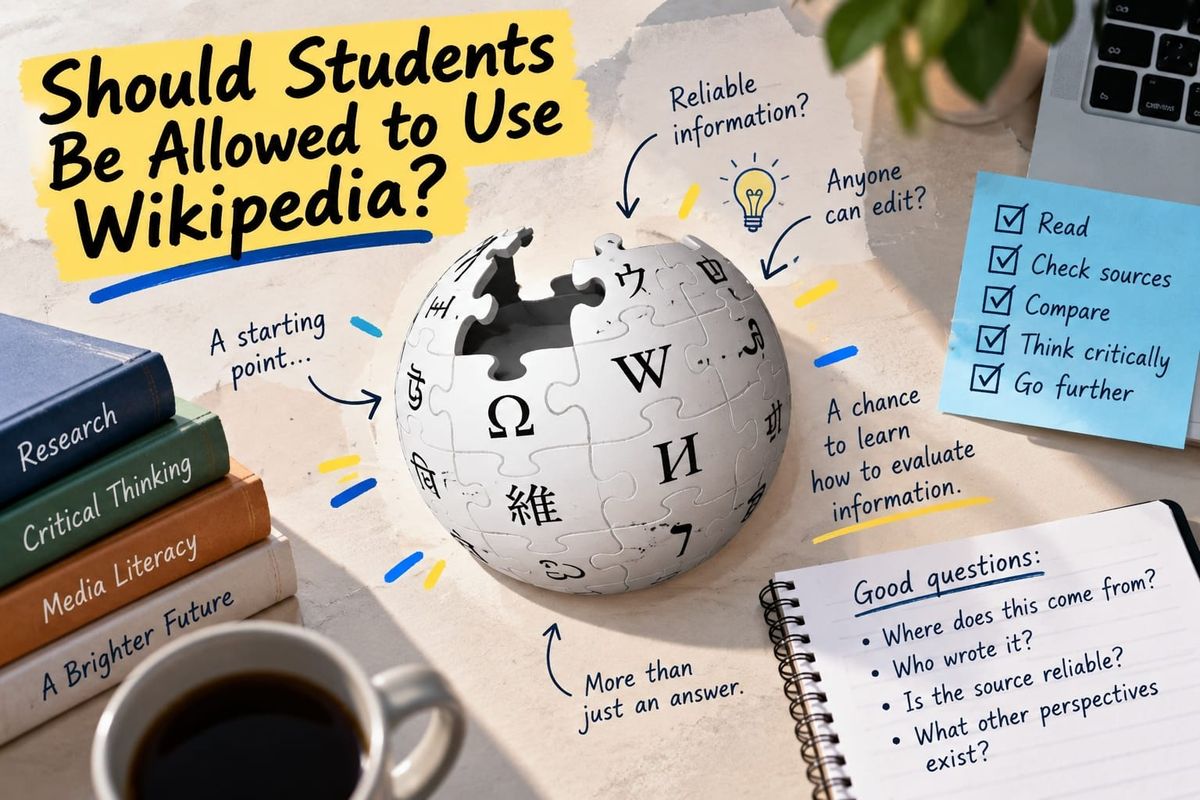
Students are going to use Wikipedia anyway. Instead of banning it, teachers can use it to teach source evaluation, research and digital literacy.
For years, students have heard some version of the same rule:
Don't use Wikipedia.
The reasoning isn't difficult to understand.
Anyone can edit it. Articles can contain errors. Wikipedia isn't a primary source. And seeing “Wikipedia” at the bottom of a bibliography doesn't exactly inspire confidence.
But there's a problem with teaching students simply to avoid it.
They're going to use it anyway.
More importantly, Wikipedia can be a surprisingly useful place to teach students something much bigger:
how to decide whether information should be trusted.
Wikipedia is a starting point, not the destination
Suppose a student needs to learn about the French Revolution.
They could search the web and immediately encounter thousands of pages of wildly different quality.
Or they could begin with Wikipedia.
A good Wikipedia article can provide:
- a broad overview
- important terminology
- names and dates
- links to related concepts
- references to other sources
That's useful.
The mistake is treating the article as the end of the research process.
Instead, it can be the beginning.
Read enough to understand the landscape. Identify the claims that matter. Then follow the references.
Teach students to click the little numbers
One of the most useful parts of Wikipedia is also one students can easily ignore.
Those little citation numbers throughout an article lead to its sources.
That's where things become educationally interesting.
Ask students to choose a claim and investigate it.
What source supports this?
Who published the source?
When was it published?
Is it a newspaper article, academic paper, government publication, book, personal website or something else?
Does the source actually support what the Wikipedia article says?
Could we find a stronger source?
Suddenly Wikipedia isn't replacing source evaluation.
It's becoming a place to practice it.
Wikipedia itself encourages readers to check citations and evaluate the reliability of the sources used in its articles.
See Wikipedia's guide to researching with Wikipedia
Look behind the article
A Wikipedia page is more than the article itself.
Open the View history page and you can see how the article changed over time.
Open the Talk page and you may find editors discussing sources, wording, neutrality and disagreements.
Some articles display warnings that additional citations are needed.
Others flag disputed claims or neutrality problems.
This exposes something students don't normally see when they open a polished web page:
information was constructed by people.
Someone chose what to include.
Someone found a source.
Someone changed a sentence.
Someone challenged it.
Someone disagreed.
Someone tried to improve it.
In January 2026, the Wikimedia education community highlighted exactly these features as opportunities for classroom learning, suggesting that students explore references, article histories and Talk pages.
Read Wikimedia's “Five ways to use Wikipedia in the classroom”
Try comparing Wikipedia with another source
Here's a simple classroom activity.
Give students a Wikipedia article and another source covering the same topic.
Then ask them:
What facts appear in both?
Where do they disagree?
Which claims have citations?
What does each source leave out?
Who created each source?
Which would you trust for which purpose?
The goal isn't to prove Wikipedia right or wrong.
The goal is to make students explain why they trust information.
That's a skill that transfers far beyond Wikipedia.
An even stranger idea: let students improve Wikipedia
Instead of asking students only to consume an article, ask them to find something that could be improved.
Maybe a claim lacks a citation.
Maybe a section is unclear.
Maybe an important perspective is missing.
Maybe one of the sources is weak.
Advanced students can go further and actually contribute to Wikipedia using reliable sources.
The Wiki Education program has supported university courses in which students improve Wikipedia articles as part of their coursework. Instead of writing only for a professor, students research and write for a public audience.
That changes the assignment in an interesting way.
A traditional paper might be read by one teacher and disappear into a folder.
A contribution to a public knowledge resource has an audience beyond the classroom.
Explore Wiki Education's student programs
But should students cite Wikipedia?
Usually, probably not.
And that's perfectly consistent with allowing them to use it.
Wikipedia describes itself as a tertiary source. Its articles summarize information found in primary and secondary sources.
For a research assignment, a stronger path is often:
Wikipedia → citation → original source
That teaches a much more useful habit than:
Wikipedia → copy information → bibliography
The same principle applies to encyclopedias and many other reference sources.
Use them to orient yourself.
Then go deeper.
What about Wikipedia in the age of AI?
There's another reason the old “never use Wikipedia” rule feels increasingly strange.
Students now have access to AI systems that can generate a confident answer to almost any question in seconds.
Unlike Wikipedia, an AI-generated answer may not clearly show who wrote the underlying information, how the answer changed over time, or which source supports each individual statement.
Wikipedia is imperfect, but much of its evidence trail is visible.
You can inspect citations.
You can inspect edits.
You can read disagreements.
You can follow sources.
That makes Wikipedia an interesting environment for teaching a skill that becomes more important, not less important, in the age of AI.
The question isn't simply whether an answer looks convincing.
It's whether students know how to investigate where it came from.
“Don't use Wikipedia” teaches the wrong lesson
The internet students are growing up with doesn't divide neatly into:
approved websites
and
bad websites.
They will encounter journalism, corporate content, government information, academic research, social posts, AI-generated answers, personal blogs, videos and anonymous claims.
Some will be reliable.
Some won't.
Some will contain a mixture.
A rule that says “never use Wikipedia” doesn't prepare students particularly well for that world.
A better rule might be:
Don't trust information merely because you found it somewhere. Learn how to investigate it.
Wikipedia happens to be a surprisingly good place to practice.
So, should students use Wikipedia?
Yes, with a condition.
Teach them what they're using it for.
Use it to understand a new topic.
Use it to discover vocabulary.
Use it to find sources.
Use it to investigate citations.
Use it to compare accounts.
Use it to see how public knowledge gets constructed.
Then teach students to go beyond it.
Because the goal isn't to produce students who know which websites they're allowed to visit.
It's to produce students who know what to do when they get there.
Sources
Wikimedia Foundation (2026). Wikipedia at 25: Five ways to use Wikipedia in the classroom.
Read the article
Wikipedia. Researching with Wikipedia.
Read the guide
Wiki Education. Teach with Wikipedia.
Explore the program