The New PISA Results Are Out. Here’s What They Say About AI, Reading and Learning
The latest PISA results are out, and the headline is not encouraging.
Across OECD countries, average performance in reading and mathematics has fallen to the lowest level ever recorded by PISA.
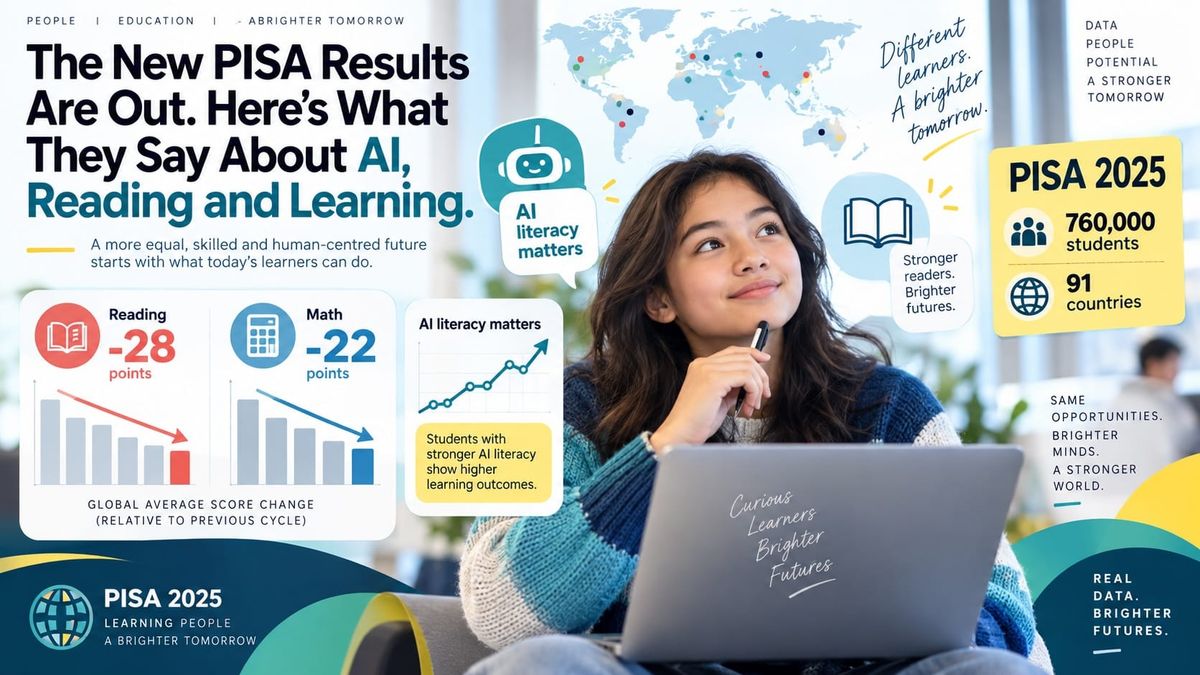
Reading scores are now 28 points lower than in 2015, which the OECD describes as roughly one and a half years of learning.
Mathematics scores are down 22 points, or a little over one year of learning.
But the 2025 results also include something new:
A much closer look at how students are using AI and digital tools.
And the picture is more complicated than “AI is good” or “AI is bad.”
Read the OECD PISA 2025 overview
The biggest PISA assessment yet
PISA 2025 involved more than 760,000 15-year-olds across 91 countries and economies.
Those students represent roughly 33 million teenagers worldwide.
Science was the main subject this time, alongside reading and mathematics.
For the first time, PISA also looked more closely at how students learn and solve problems in a digital environment.
Read the full 377-page PISA report
Reading is falling in exactly the skills AI makes more important
The OECD highlights one particularly worrying trend.
Reading performance has declined most in skills such as:
- evaluating information
- connecting ideas across multiple sources
- distinguishing fact from opinion
- dealing with ambiguity
- thinking critically about what we read
Those are not becoming less important because AI exists.
They may be becoming more important.
If an AI system can generate a confident answer instantly, students need to be able to decide whether that answer is reliable.
The OECD also reports that the share of what it calls “hasty readers”, students who rush through texts and give quick but incorrect answers, has almost doubled since 2018.
Students who do not use AI often score higher
PISA 2025 also asked students how they use AI chatbots for schoolwork.
On average across OECD countries, AI use is now widespread.
But regular use does not automatically correspond with better performance.
Students who reported not using AI for specific schoolwork tasks generally outperformed students who used it.
This included activities such as:
- summarising assigned texts
- doing preliminary research
- drafting written assignments
That does not prove AI caused lower scores.
The OECD explicitly warns that the relationship is complex.
Students who struggle more may simply be more likely to turn to AI.
Still, the pattern is worth noticing.
Moderate use looks different from heavy use
The picture changes when students use AI more deliberately.
Among students using AI to help them learn, moderate users often performed similarly to or better than students using it very rarely or very frequently.
The OECD describes the broader pattern as one where purposeful and moderate use can support learning, while excessive or unguided use may be associated with distraction and shallower engagement.
That sounds less like an argument against AI and more like an argument against handing students a chatbot without teaching them what to do with it.
AI literacy seems to matter
This may be the most interesting finding.
Around six in ten students across OECD countries said they had been asked in school to assess the quality of AI-generated information.
Among students who used AI frequently for learning, those who had opportunities to learn how to evaluate AI-generated information tended to achieve slightly higher science scores than students who used AI without that guidance.
Again, this is correlation, not proof of cause.
But the implication is important:
Access to AI may matter less than knowing how to question it.
The OECD also found that these AI-literacy opportunities were more common among socio-economically advantaged students, raising the possibility of a new kind of digital divide.
Family support is falling too
AI is only one part of the story.
Students reported less family support than in 2022 in almost every country and economy with available data.
The decline was particularly noticeable among boys and disadvantaged students.
At the same time, students who reported stronger day-to-day interest and support from parents or guardians tended to perform better in science.
That makes the overall PISA story broader than technology.
Students are learning in environments shaped by:
- teachers
- families
- peers
- devices
- AI
- attention
- school climate
None of those factors operates alone.
The most important PISA message may be quite old-fashioned
The OECD Secretary-General summarized the technology problem in a surprisingly simple way:
AI can strengthen learning, but it should not replace attention, effort and understanding.
That may be the most useful takeaway from PISA 2025.
Students probably do need AI literacy.
They probably do need experience using digital tools.
But they still need to read carefully.
Think.
Check information.
Solve problems.
Ask questions.
And understand enough to notice when a tool gives them a bad answer.
The technology is changing quickly.
The foundations of learning may be changing much less.
Sources
OECD: PISA 2025 students’ reading and mathematics performance declined sharply across the OECD
OECD: PISA 2025 Results, Volume I: Future-Ready Students
OECD: Students’ use of artificial intelligence for schoolwork
OECD: PISA findings on artificial intelligence use, reading skills and learning