What Makes EdTech Actually Work? 9 Things Researchers Found Across 189 Studies
Schools have spent years buying devices, subscribing to platforms and experimenting with new classroom technology.
But there's an awkward question underneath all of it:
What actually makes educational technology improve learning?
In 2025, the Education Endowment Foundation (EEF) published a large review that tried to answer exactly that. Researchers examined 189 studies of EdTech interventions, combining a systematic review and meta-analysis with input from teachers and other education professionals.
Their conclusion wasn't a list of the best apps.
Instead, they identified nine groups of mechanisms associated with effective EdTech.
And perhaps the most useful thing about the list is how little it has to do with technology itself.
The full review is publicly available from the EEF:
Review of evidence on EdTech interventions for disadvantaged pupils
The 9 things at a glance
Don't have time for the whole article? Here's the short version.
- Start with pedagogy, not technology — technology works best when it supports good teaching rather than trying to replace it.
- Design for inclusion and accessibility — a tool isn't effective if some learners can't meaningfully use it.
- Use different media when they help learning — text, audio, images, video and interactive elements can offer different ways into the same material.
- Make feedback useful and timely — one of technology's strengths is its ability to respond to learners while they're still working.
- Use technology to adapt teaching — digital tools can help adjust content, difficulty and support to learner needs.
- Plan the implementation, not just the purchase — even promising technology can fail when schools don't plan how it will actually be used.
- Help students reflect and take ownership — technology can support more personalised and reflective learning environments rather than simply delivering content.
- Treat gamification as a teaching strategy, not decoration — points and games aren't automatically educational; how they're integrated matters.
- Use technology to support collaboration — digital tools can help students learn together, but collaboration still needs structure.
1. Start with pedagogy, not technology
This is the first mechanism identified in the review, and arguably the most important.
The researchers describe it as grounding technology in pedagogical processes.
In normal language: don't start with the tool.
Start with what you're trying to teach.
A digital game, quiz, AI tutor or interactive activity doesn't become effective simply because students are engaged with it. It has to fit into a larger teaching process.
The EEF gives an example of a teacher using a digital game alongside evidence-informed strategies such as assessing students beforehand and providing ongoing small-group instruction.
The technology is part of the teaching.
It isn't the teaching.
This seems obvious when written down. But it runs against the way educational technology is often introduced:
We have bought this platform. How can we use it?
A better order is:
We have this teaching problem. Can technology help us solve it?
That small reversal may prevent a lot of unnecessary EdTech.
2. Design for inclusion and accessibility
The second mechanism is particularly interesting because it became clearer when researchers combined the published evidence with practitioner input.
Technology can make learning more accessible.
An e-book might provide built-in definitions or decoding assistance. Text can be enlarged. Content can be read aloud. Students can sometimes work at their own pace or access the same material through different formats.
But technology can also create new barriers.
A tool that works beautifully for most students isn't necessarily successful if another group struggles to access it.
That means accessibility shouldn't be something considered after choosing a tool.
It should be part of the decision.
Who will find this easier to use — and who might find it harder?
That's a surprisingly useful question when evaluating almost any classroom technology.
3. Use different media when they help learning
Digital tools can combine things paper often can't: text, diagrams, audio, animation, video, interactive exercises and other forms of media.
The EEF groups this under applying diverse media for learning.
The important word, though, is probably learning.
Adding a video to a page doesn't automatically improve it.
Neither does an animation, illustration or interactive element.
Different media become useful when they help explain something, provide another way to understand it or make otherwise difficult material more accessible.
This is an important distinction in an era when it's increasingly easy to make educational material look impressive.
More media isn't necessarily better media.
The question is whether each element is helping the student understand something.
4. Make feedback useful and timely
Technology has one enormous practical advantage over many traditional learning materials:
It can respond.
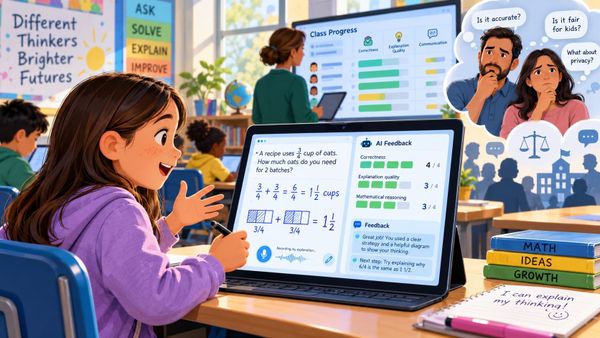
A worksheet can't immediately tell a student that they've misunderstood something. Software can.
The EEF identifies dynamic feedback mechanisms as another important group.
This doesn't necessarily mean displaying a red cross and revealing the correct answer.
Good feedback can explain an error, offer a hint, prompt another attempt or help a student understand why their answer didn't work.
And it can happen while the student is still engaged with the problem.
That's potentially much more useful than discovering days later that question seven was wrong.
With generative AI making feedback increasingly easy to produce, this mechanism is probably going to become even more important.
The challenge will be making feedback good, not merely instant.
5. Use technology to adapt teaching
One of EdTech's longest-standing promises is personalisation.
The EEF's review identifies a more concrete version of that idea: leveraging technology for adaptive teaching.
A digital system can change the difficulty of a task, provide additional support, select different material or respond to what a learner has already demonstrated.
That's something technology can genuinely do at a scale that's difficult to reproduce manually.
But there's an important distinction between adaptation and simply giving every student a different stream of algorithmically selected content.
Teachers still need to understand what is happening and why.
The useful version of adaptive technology helps teaching respond to learners.
It doesn't make the teacher irrelevant.
6. Plan the implementation, not just the purchase
This may be the least glamorous item on the list.
It's also one of the most practical.
The EEF identifies planning implementation practices as one of the mechanisms behind successful EdTech.
Schools don't use technology in a laboratory.
Teachers need time to understand it. Students need to know how to use it. Devices need to work. Accounts need to exist. The technology has to fit existing routines, curricula and systems.
A potentially excellent tool implemented badly can easily become a bad tool in practice.
This is one reason EdTech comparisons based purely on feature lists can be misleading.
Two schools can buy exactly the same product and get very different results.
The difference may have less to do with the software than with what happens after somebody clicks Purchase.
7. Help students reflect and take ownership
Another mechanism identified in the review is creating reflective and personalised environments.
Technology doesn't only have to deliver information.
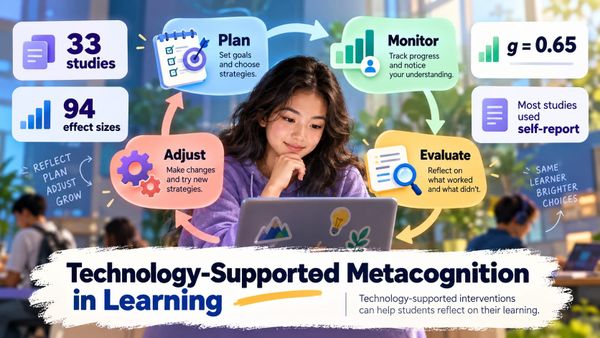
It can help students see their progress, revisit previous work, make choices, receive personalised support and think about their own learning.
This is quite different from using technology as a more colourful worksheet.
A good digital environment can make learning more visible to the learner.
What have I completed?
Where am I struggling?
What has changed since my first attempt?
What should I work on next?
Those are useful questions with or without technology.
Technology can simply make answering them easier.
8. Treat gamification as a teaching strategy, not decoration
Games and gamification appear among the nine groups too.
That doesn't mean the research says every lesson needs points, badges and leaderboards.
The mechanism is specifically about managing game-based learning and gamification.
That's an important distinction.
A game can encourage repeated practice, provide rapid feedback, create meaningful challenges and give students opportunities to try again.
Or it can add a scoreboard to an activity without changing the learning at all.
Students having fun isn't a bad outcome.
But engagement and learning aren't synonyms.
If a game is being used educationally, it's worth asking:
What are students repeatedly thinking about or practising while playing it?
That's probably more important than how entertaining the game looks.
9. Use technology to support collaboration
The final group is scaffolding collaborative learning.
Digital tools make it incredibly easy for students to share, comment, contribute and work together.
But putting four students into the same digital space doesn't automatically create productive collaboration.
The word scaffolding matters.
Students may need roles, prompts, shared goals, structured tasks or guidance about how to respond to one another.
Technology can provide the environment.
Teaching still provides the structure that makes the environment useful.
There's an important warning in the research
The EEF commissioned this review specifically with socio-economically disadvantaged pupils in mind.
And this is where the findings become less comfortable.
Overall, the review found a positive average effect from EdTech interventions.
But the evidence specifically concerning disadvantaged pupils was much thinner, and the average effect for disadvantaged pupils was smaller than the overall average.
In other words, technology that improves outcomes overall doesn't automatically close an attainment gap.
It may even widen it.
Access is an obvious part of this. Devices, connectivity, quiet places to work and familiarity with technology aren't distributed equally.
But implementation matters too.
If some students need additional support to benefit from a tool and don't receive it, giving everyone access to the same technology isn't necessarily giving everyone the same opportunity.
That's worth remembering whenever technology is presented as an automatic route to greater educational equality.
Maybe we're asking the wrong question about EdTech
The most interesting thing about these nine mechanisms is what's missing.
There's no particular device.
No platform.
No trendy category of software.
No instruction to make lessons more digital.
Instead we get pedagogy, accessibility, feedback, adaptation, implementation, reflection, collaboration and thoughtful use of media and games.
Which leads to a rather unexciting but useful conclusion:
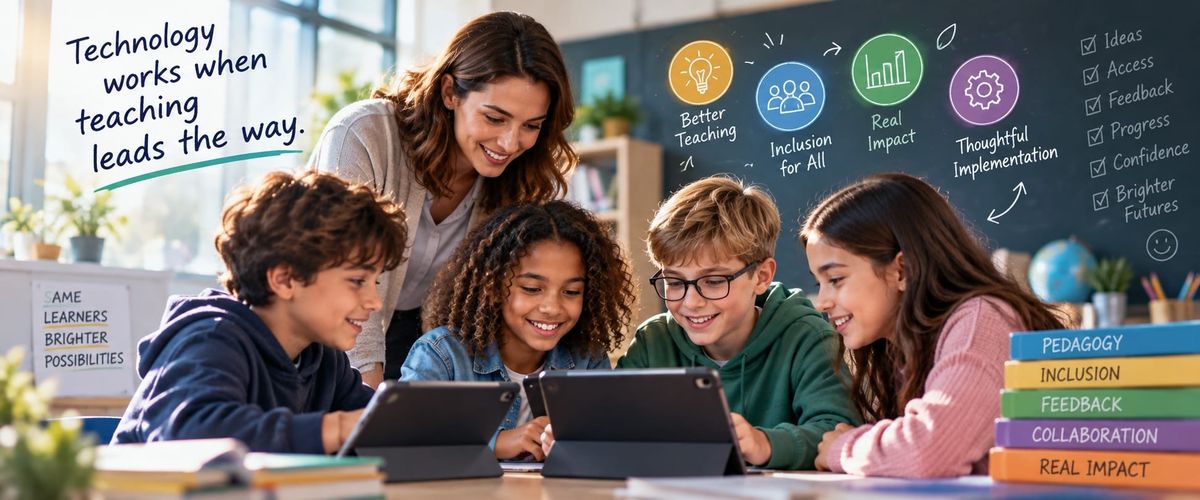
Good EdTech seems to work when it helps good teaching work better.
That also gives teachers a much more practical way to evaluate the next tool that arrives in their inbox.
Don't just ask:
What can this tool do?
Ask:
What will this help me or my students do better?
If the answer isn't clear, perhaps the technology isn't solving a problem yet.
Source: Haßler, B., Huntington, B., Klune, C., Lester, J., Bhutoria, A. and Mansour, H. (2025), Understanding quality characteristics of EdTech interventions and implementation for disadvantaged pupils. Review commissioned by the Education Endowment Foundation.