What Makes Multimedia Learning Work? What 181 Studies Actually Found
Add a diagram.
Break the lesson into smaller sections.
Highlight important words.
Add narration.
Use animation.
Turn it into a simulation.
Make it interactive.
Teachers and instructional designers have been given advice like this for decades.
But which of these changes actually help students learn?
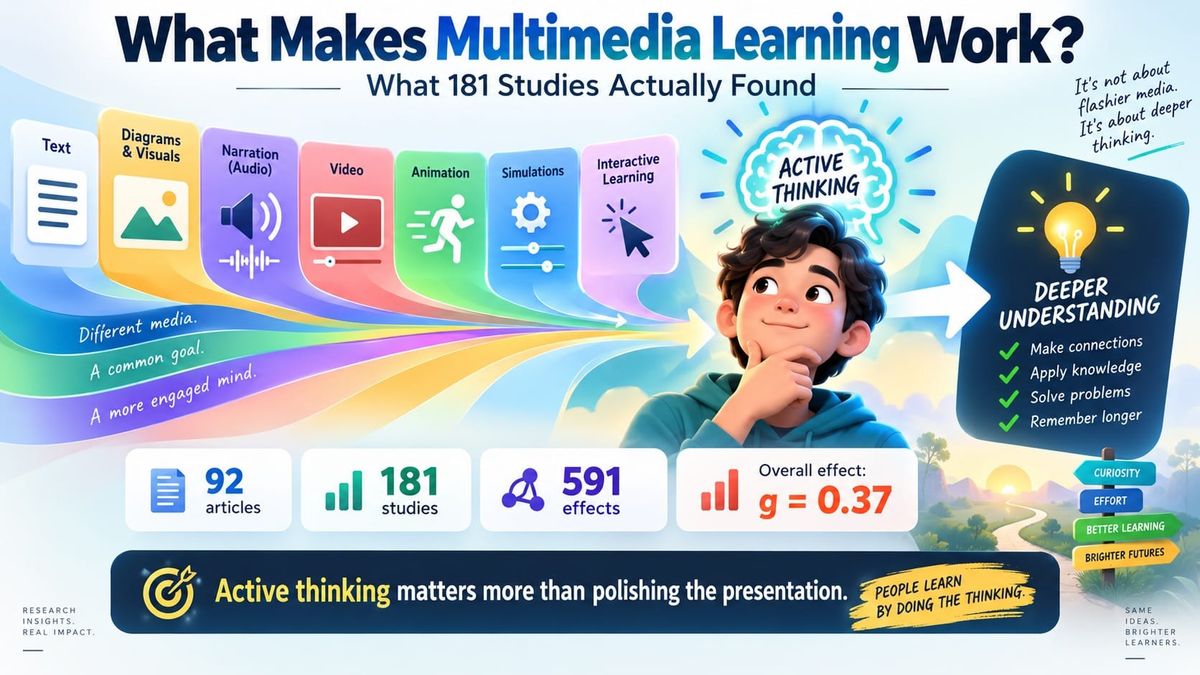
A 2025 meta-analysis revisited more than 30 years of research by educational psychologist Richard Mayer, one of the most influential researchers in multimedia learning.
The researchers analyzed:
- 92 research articles
- 181 separate studies
- 591 effects
Their conclusion was more complicated than a simple list of design rules.
Multimedia can improve learning.
But not all design principles work equally well, not all technologies produce the same results, and some of the strongest effects came from getting learners to think actively rather than simply improving the appearance of the material.
The short version
Across Mayer's multimedia-learning research, the overall effect was:
g = 0.37
That is a meaningful positive effect.
But the average hides large differences.
Some principles produced substantial improvements:
- removing distracting or irrelevant details: g = 1.00
- modality principle: g = 0.82
- personalization: g = 0.70
- combining verbal and visual information: g = 0.68
- sentence-level coherence: g = 0.63
- self-explanation: g = 0.46
Other commonly discussed principles showed much smaller or statistically uncertain average effects.
And when the researchers stepped back from individual rules, one pattern stood out:
Active learner involvement tended to matter more than surface-level design changes.
181 studies across more than 30 years
The researchers examined Mayer's peer-reviewed multimedia-learning studies published between 1990 and 2022.
Multimedia learning was defined broadly.
It included combinations such as:
- text and diagrams
- narration and images
- animation
- video
- simulations
- educational games
- virtual reality
The studies covered different subjects, ages, countries and learning outcomes.
That gave the researchers an opportunity to ask something more useful than:
Does multimedia work?
They could ask:
When does it work, for whom, and for what kind of learning?
The overall effect was positive
Across all 591 effects, the average was:
g = 0.37
So, overall, the multimedia interventions in Mayer's research improved learning.
But the effects varied substantially.
The researchers found meaningful differences depending on:
- the design principle being tested
- the type of multimedia
- student age
- subject area
- the kind of learning being measured
- where and when the research was conducted
That means there is no single universal “multimedia effect.”
How the material is designed still matters.
Removing interesting distractions had one of the biggest effects
One result is particularly relevant to modern educational content.
The strongest average effect among the design principles came from removing seductive details:
g = 1.00
“Seductive details” are interesting elements that attract attention but do not support the learning goal.
That could be:
- an entertaining but irrelevant image
- an interesting fact that does not help explain the concept
- decorative animation
- unnecessary sound effects
- a story that is memorable but unrelated to what students need to understand
This is an uncomfortable lesson for anyone designing digital materials.
Making something more interesting does not necessarily make it more educational.
Sometimes the best design decision is simply:
Remove the thing that does not need to be there.
Personalization helped too
Another relatively strong principle was personalization:
g = 0.70
In Mayer's research, this generally involves presenting information in a more conversational rather than highly formal style.
Compare:
“The learner should now observe the following process.”
with:
“Now let's look at what happens next.”
The content may be identical.
But the second version feels more like communication between people.
The meta-analysis suggests that this kind of social framing can meaningfully influence learning.
Words plus visuals still matter
The classic multimedia principle also performed well.
Presenting information through both verbal and visual forms rather than through a single medium produced an average effect of:
g = 0.68
This supports one of the central ideas behind multimedia learning:
A useful diagram does not merely decorate the text.
It can represent relationships that are difficult to express efficiently in words.
Think about:
- the water cycle
- the structure of a cell
- a historical timeline
- forces acting on an object
- the relationship between variables in a graph
Sometimes seeing the structure is part of understanding it.
But adding motion is not automatically better
Animation sounds more advanced than a static diagram.
The results were much less straightforward.
When the researchers compared different multimedia types, animation showed a positive average effect.
But animation as a specific design principle did not show a statistically significant advantage over static multimedia.
That distinction matters.
Movement itself is not necessarily the useful ingredient.
An animation may help when motion is essential to understanding the process.
But turning a static explanation into an animated one simply because the technology allows it does not guarantee better learning.
VR was surprisingly unimpressive
Virtual reality often sounds like the ultimate multimedia-learning technology.
In this research corpus, it was not.
Across multimedia types, VR had a small average effect:
g = 0.17
and that result was not statistically significant.
The specific immersion principle also showed no significant positive effect.
That does not prove that VR cannot help learning.
The VR evidence in Mayer's work came from a narrower and more recent set of studies.
But it does challenge a common assumption:
More immersive technology is not automatically more educationally powerful.
A good diagram may sometimes outperform a headset.
Text and diagrams were remarkably reliable
One of the less glamorous findings may be one of the most useful.
Text plus diagrams showed a consistent positive effect:
g = 0.45
The researchers found benefits across factual learning, inference and transfer.
That is worth noticing.
Educational technology often moves toward increasingly complex formats.
Video.
Games.
Simulation.
VR.
Yet a carefully designed explanation with a useful visual remains remarkably effective.
Sometimes the boring technology works.
Getting students to do something mattered
This may be the most interesting conclusion of the paper.
The researchers grouped many of Mayer's principles into broader categories.
They found that approaches involving active learner participation, including generative activities such as self-explanation, tended to produce stronger learning benefits than many traditional layout-oriented principles.
Self-explanation alone showed an average effect of:
g = 0.46
The testing effect was:
g = 0.41
Scaffolding:
g = 0.38
By contrast, several familiar design adjustments produced relatively small or statistically non-significant average effects.
Examples included:
- segmenting
- contiguity
- redundant captions
- cueing
- voice
- social presence
The authors summarize the broader pattern clearly:
More active learner involvement appears more beneficial than simply changing the layout of the material.
Better slides are not the same as better learning
This may be the most useful classroom interpretation.
Imagine two versions of the same digital lesson.
Version A
The teacher:
- changes the layout
- adds highlights
- improves the animation
- changes the voice
- adds transitions
- adjusts where text appears
Version B
The student has to:
- explain what just happened
- answer a question
- predict the next step
- identify the important relationship
- apply the idea somewhere new
Both are forms of instructional design.
But the meta-analysis suggests that Version B may often be the more important investment.
That does not mean presentation is irrelevant.
Poor design can create unnecessary cognitive load.
But once the material is reasonably clear, making students think may matter more than polishing it further.
The learning goal changes the answer
Another major finding was that different principles worked differently depending on what researchers measured.
There is a difference between remembering facts and being able to transfer knowledge to a new problem.
A design choice might help one outcome more than another.
For example, a teacher introducing vocabulary may need something very different from a teacher asking students to use a scientific principle in an unfamiliar situation.
So asking:
“What is the best multimedia design?”
may be the wrong question.
A better one is:
“What kind of thinking do I want students to do after seeing this?”
The effects became smaller over time
The researchers also found a small decline in effect sizes across publication years.
There are several possible explanations.
Later research involved:
- more diverse learners
- more countries
- more technologies
- different educational settings
Early effects found in tightly controlled experiments may not always reproduce at the same size when technologies and populations become more varied.
This is another useful reminder not to treat instructional principles as universal laws.
They have boundaries.
A simple checklist for teachers
This research does not require teachers to memorize dozens of multimedia principles.
A simpler checklist may be enough.
Before adding something to a digital lesson, ask:
Does this element help explain the idea?
If not, consider removing it.
Could a visual show something that words alone make difficult to understand?
If yes, use one.
Am I adding animation because motion matters, or simply because I can?
Those are different reasons.
And finally:
What does the student have to do with this information?
Explain it?
Retrieve it?
Predict something?
Apply it?
Compare it?
Because the strongest lesson from 181 studies may be this:
Good multimedia is not only about what students see and hear.
It is about what the material gets them to think about.
Source
Cromley, J. G. & Chen, R. (2025).
A meta-analysis of Richard Mayer's multimedia learning research: Searching for boundary conditions of design principles across multiple media types. Educational Research Review, 49, 100730.