What Makes Peer Feedback Actually Work? A Meta-Analysis of 32 Studies
A 2025 meta-analysis of 32 studies found that peer feedback works better when students are given structured support, especially when they are taught how to give useful feedback.
Peer feedback sounds simple.
Ask students to review each other's work. Let them comment. Maybe give them a rubric.
But anyone who has tried it knows the results can vary enormously.
Some students write thoughtful, useful comments.
Others write:
“Looks good.”
or
“I agree.”
A 2025 meta-analysis looked at exactly this problem.
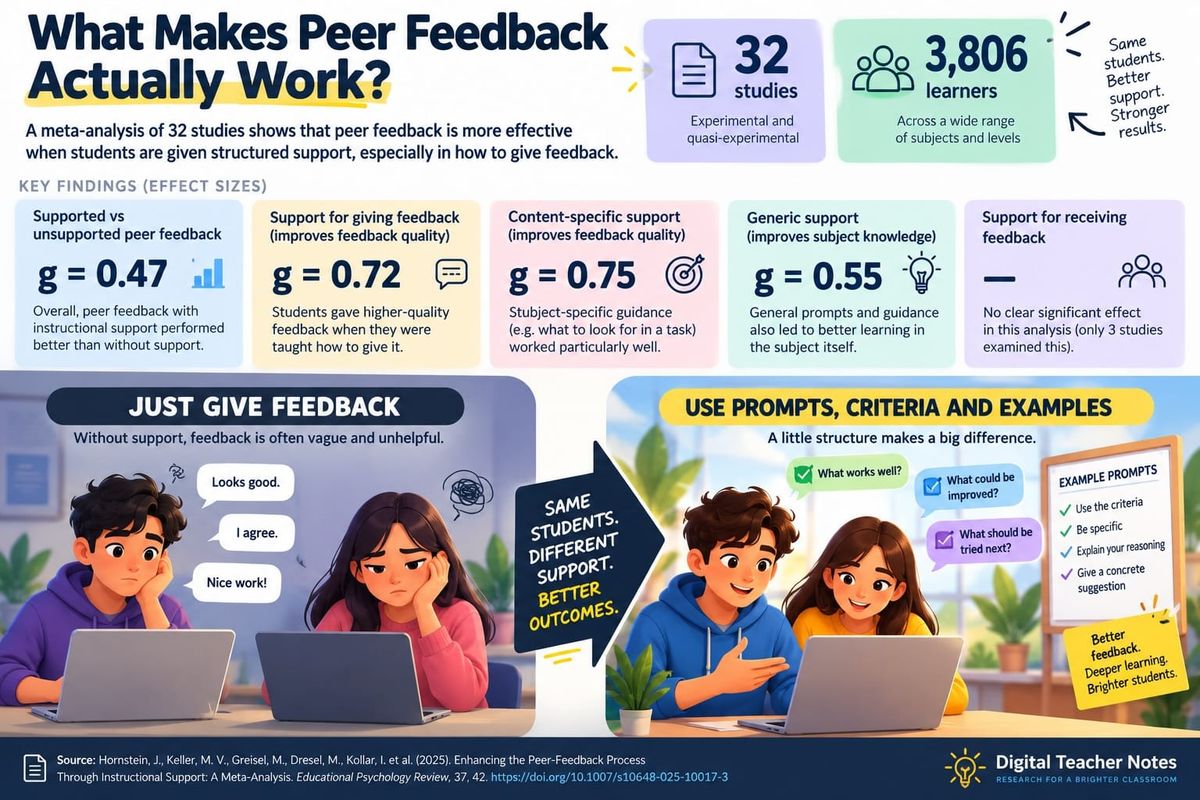
Researchers reviewed 32 studies involving 3,806 learners to ask whether students benefit more from peer feedback when they are given structured support.
The answer was yes.
But the more interesting finding was where that support mattered most.
The short version
The meta-analysis found that:
- Peer feedback with instructional support performed better overall than peer feedback without support.
- The overall effect was g = 0.47.
- Support aimed at helping students give better feedback had a strong effect on feedback quality.
- Content-specific support for giving feedback produced an effect of g = 0.75.
- Generic support for giving feedback produced an effect of g = 0.70.
- Generic support also improved subject knowledge, with an effect of g = 0.55.
- Support aimed only at helping students receive feedback did not show clear significant effects in this analysis.
The practical message is surprisingly simple:
If you want peer feedback to work, teach students how to give it.
Read the full open-access meta-analysis
32 studies, 3,806 learners
The researchers searched several major academic databases and screened hundreds of papers.
They eventually included 32 peer-reviewed experimental or quasi-experimental studies.
Across those studies, they compared peer-feedback activities that included some form of instructional support with peer-feedback activities that did not.
That support could include things such as:
- rubrics
- guiding questions
- sentence starters
- examples
- preparatory activities
- explicit criteria
- prompts for reviewing someone else's work
The researchers then looked at three main outcomes:
- How good was the feedback students gave?
- How effectively did students use the feedback they received?
- Did students learn more about the subject itself?
Structured peer feedback worked better
Overall, adding instructional support improved the peer-feedback process by g = 0.47.
That is important because the comparison wasn't between peer feedback and doing nothing.
Both groups were already participating in peer feedback.
The difference was whether students received additional support to help them do it effectively.
So the result suggests that simply adding some structure can make an already useful learning activity noticeably better.
Helping students give feedback had the clearest effect
This may be the most useful finding for teachers.
When students were explicitly supported in giving feedback, the quality of the feedback they produced improved substantially.
The effect size was:
g = 0.72
The same support was also associated with better use of feedback by the receiving student:
g = 0.69
In other words, teaching students how to critique someone else's work may improve more than the comments themselves.
The process of evaluating another student's work may also help students think more carefully about quality, criteria and their own work.
Specific guidance worked particularly well
The researchers separated support into two broad types.
Content-specific support
This might tell students what to look for in a particular task.
For example:
Does the argument include evidence?
Does each step in the solution follow logically from the previous one?
Does the explanation correctly distinguish evaporation from condensation?
When students received this kind of content-specific support while giving feedback, the quality of their feedback improved by:
g = 0.75
That's one of the strongest effects in the analysis.
Generic support
Generic support isn't tied to a particular subject.
It might include prompts such as:
Identify one strength.
Point out one place that could be clearer.
Explain why you think a change would improve the work.
This also improved feedback quality:
g = 0.70
And unlike content-specific support, generic support was also associated with an improvement in subject-matter knowledge:
g = 0.55
That's an interesting result.
Even relatively simple prompts may encourage students to think more deeply about what makes work effective.
Giving feedback may be part of the learning
This fits with a broader idea in learning research.
The person receiving feedback isn't necessarily the only one who benefits.
To give useful feedback, a student has to compare someone else's work with a standard.
They have to ask:
What is good here?
What is missing?
Why is this explanation unclear?
What would I change?
That requires evaluation.
And evaluation can expose gaps in the reviewer's own understanding.
Peer feedback therefore isn't only a way to save the teacher from commenting on every piece of work.
Giving feedback can itself become a learning activity.
What about helping students receive feedback?
Here the results were much less clear.
The meta-analysis did not find significant effects for instructional support aimed specifically at helping students receive and process peer feedback.
That doesn't necessarily mean this kind of support is useless.
There was a major limitation:
Only three studies in the meta-analysis examined support focused on feedback reception.
That is far too small a research base to draw a strong conclusion.
The authors explicitly caution that much more research is needed here.
So the useful interpretation isn't:
“Don't help students use feedback.”
It's:
“We currently have much stronger evidence for helping students give feedback than for any particular strategy for receiving it.”
Peer feedback isn't automatically useful
This may be the biggest practical takeaway.
Putting students into pairs and saying:
“Give each other feedback.”
doesn't guarantee much.
Students may not know what good work looks like.
They may not know what to look for.
They may avoid criticism because they don't want to upset a classmate.
Or they may identify a problem but have no idea how to explain it constructively.
The research suggests that a relatively small amount of structure can change the quality of the activity considerably.
A simple classroom version
You probably don't need a complex peer-assessment system.
A useful structure could be as simple as three prompts:
1. What works well?
Identify one specific part of the work that is effective.
2. What could be improved?
Identify one specific place where the work could be clearer, stronger or more accurate.
3. What should the student try next?
Suggest one concrete change.
For a particular subject, add one or two content-specific questions.
For example, in an argumentative essay:
Is every major claim supported by evidence?
For maths:
Can you follow every step of the reasoning?
For science:
Does the explanation correctly connect cause and effect?
That is very different from simply telling students to “comment on each other's work.”
The surprising lesson
Peer feedback is often treated as something students receive.
This research suggests we should pay at least as much attention to the student giving it.
The process of judging, comparing and explaining may be where a significant part of the learning happens.
So if peer feedback in your classroom tends to produce comments like:
“Nice work.”
the problem may not be peer feedback itself.
Students may simply need to be taught how to do it.
Source
Hornstein, J., Keller, M. V., Greisel, M., Dresel, M., Kollar, I. et al. (2025). Enhancing the Peer-Feedback Process Through Instructional Support: A Meta-Analysis. Educational Psychology Review, 37, 42.