When an AI Chatbot Replaces a Tutorial, What Does the Student Lose?
An Australian university is using an AI chatbot in two compulsory psychology subjects. The experiment raises a bigger question about what students lose when human tutorials disappear.
AI is increasingly being used to help students study.
At Macquarie University in Australia, it is now playing a more direct role in teaching.
Two compulsory online psychology subjects are using an AI chatbot called Virtual Peer to guide students through weekly learning activities.
The university says the chatbot is designed to support students, not replace educators.
But there is an important detail:
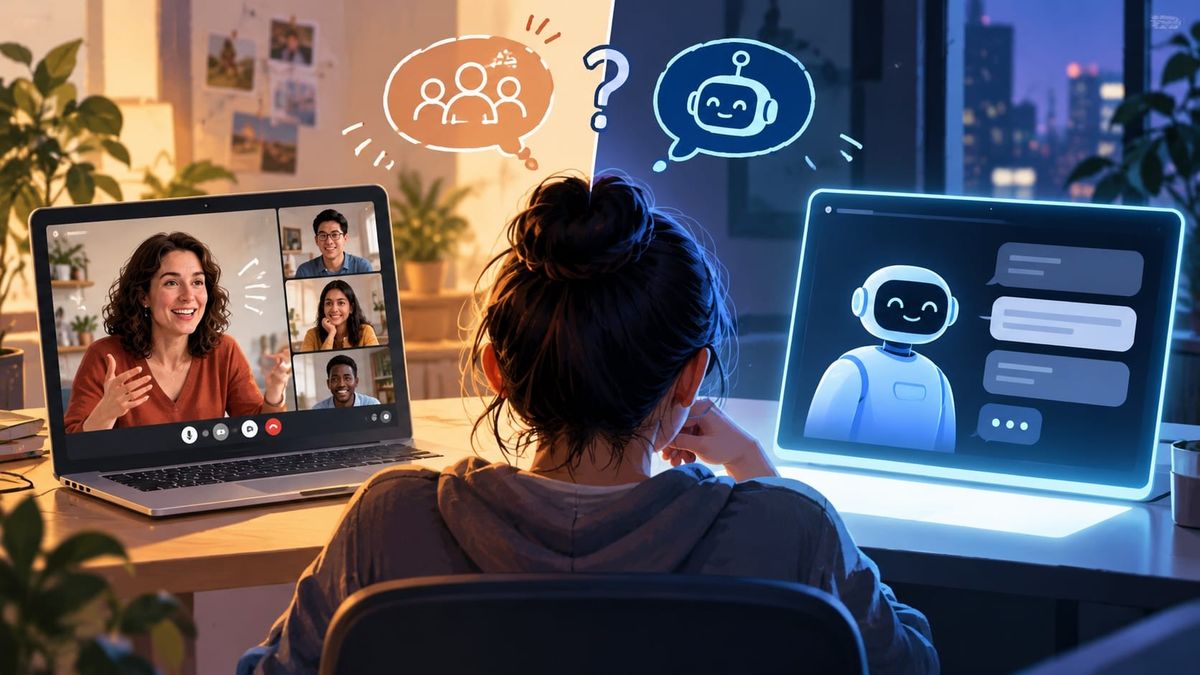
Those subjects previously included weekly Zoom tutorials led by academics.
Now, the main weekly learning activities are built around videos and conversations with the chatbot instead.
What does the AI actually do?
Virtual Peer asks students questions, presents scenarios and guides them through exercises related to their course material.
Macquarie says academics design and review the content behind the system, helping keep its responses aligned with the subject.
Students are not graded on their chatbot conversations. Formal assessment still comes from separate assignments and exams.
The university also says using Virtual Peer is optional.
But for students taking these subjects online, the experience is clearly different from joining a live tutorial with a teacher and classmates.
Some students feel something is missing
Not everyone is convinced by the change.
Some students told The Guardian that they felt they were receiving less human interaction than they expected from their degree.
That raises an interesting question.
An AI tutor can explain something again.
It can ask another question.
It can respond immediately and keep going for as long as the student wants.
But a university tutorial can provide something else.
Students hear other people misunderstand an idea.
They challenge each other's arguments.
A teacher notices confusion that nobody has expressed directly.
A discussion moves somewhere unexpected.
Those moments are difficult to reproduce with a chatbot.
Efficiency isn't the only measure
There are good reasons for universities to experiment with AI.
A chatbot can be available at any time.
It can provide additional practice.
It may help students who are reluctant to ask questions publicly.
And one system can support very large numbers of students.
But if AI makes teaching more scalable while reducing meaningful interaction, that creates a different kind of trade-off.
The question isn't simply:
Can AI perform part of a tutorial?
It clearly can.
A better question may be:
Which parts of a tutorial are valuable precisely because another human is there?
A useful experiment to watch
Macquarie isn't the only university experimenting with AI-supported teaching, and systems like Virtual Peer will probably become more common.
That makes this more than a story about one psychology course in Australia.
Schools and universities may soon need to distinguish between two very different uses of AI:
AI that gives students more opportunities to learn
and
AI that replaces opportunities they previously had to learn with other people.
The technology might look similar in both cases.
The educational experience may not be.
Source
The Guardian: AI chatbot helps teach online-only psychology classes at Macquarie University