Why Students Forget What They Learn and What Teachers Can Do About It
Students can understand something today and forget it next week. Research on retrieval practice and spacing offers practical ways to make learning stick.
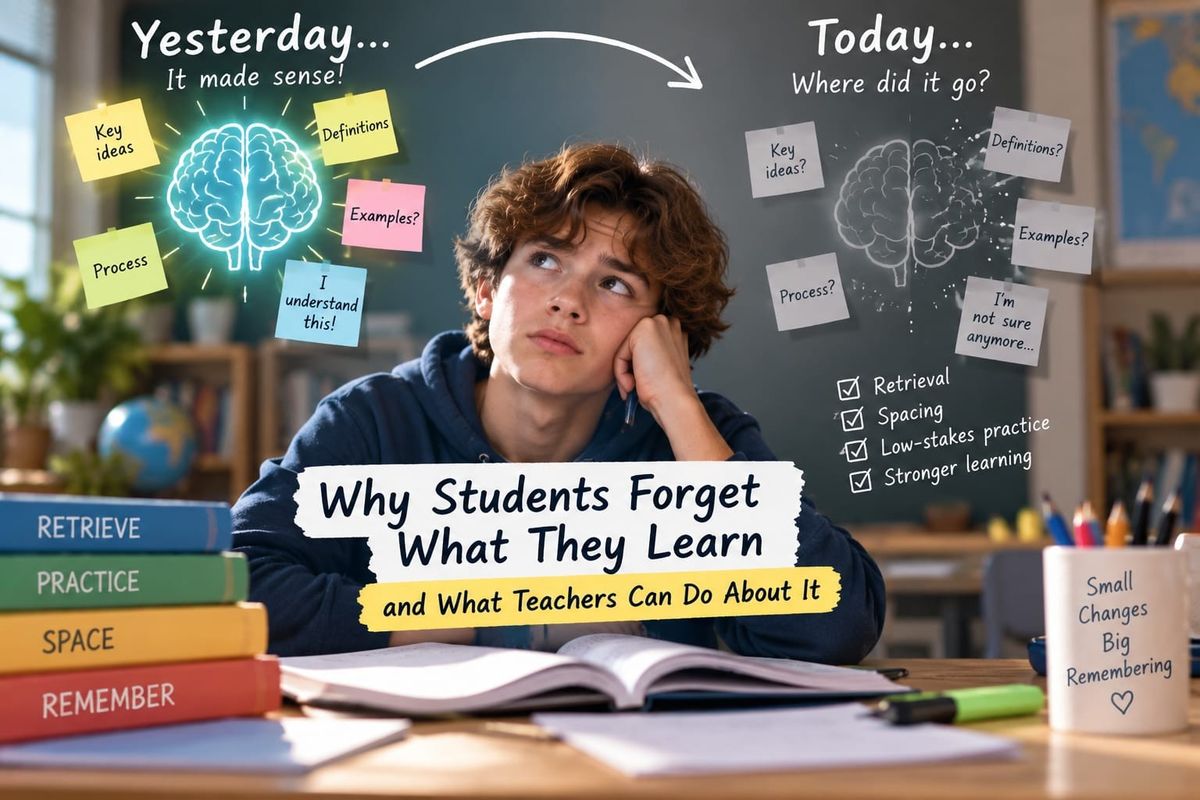
A student understands something perfectly on Tuesday.
By Friday, half of it seems to have disappeared.
A month later, the class returns to the topic and it feels as though everyone is starting again.
It's frustrating. It's also normal.
Forgetting isn't necessarily evidence that teaching failed. Human memory loses information that isn't used.
The more interesting question is:
What can we do to make important learning stick?
Two of the best-supported answers from cognitive science are remarkably simple:
Make students retrieve information. Then come back to it later.
The short version
Research on memory and learning points to a few practical ideas:
- Rereading can create an illusion of learning because recognizing information isn't the same as recalling it.
- Retrieval is part of learning because trying to remember something can strengthen the memory itself.
- Some difficulty can be useful when students have to work to retrieve an answer.
- Spacing practice improves long-term retention compared with concentrating all practice into one session.
- Old material needs to return if we expect students to remember it months later.
- Quizzes don't have to be tests and can instead become routine, low-stakes opportunities to remember.
1. Rereading can create an illusion of learning
Imagine studying a page of notes.
You read it once.
Then again.
By the third reading, everything looks familiar.
That feeling of familiarity can easily become:
I know this.
But recognizing something while it's in front of you isn't the same as being able to retrieve it later.
That's one reason students can spend an evening rereading notes and still struggle to remember the material the following week.
A more powerful approach is to close the notes and ask:
What can I remember?
That small change turns reviewing into retrieval practice.
2. Retrieval is part of learning
We usually think of quizzes and tests as ways to measure learning.
But retrieving information can itself strengthen learning.
A large body of research has found that attempting to recall previously learned information improves later retention compared with simply studying the information again.
A systematic review of retrieval practice in real classrooms found benefits across different education levels, subjects, test formats and delays.
Retrieval doesn't have to mean a formal test.
It can be:
- three questions at the beginning of a lesson
- a quick quiz
- flashcards
- writing down everything students remember
- explaining yesterday's concept to a partner
- drawing a diagram from memory
- answering a question before reopening the textbook
The important part is that the answer isn't already visible.
The student has to bring it back from memory.
Read the classroom review of retrieval practice
3. Some difficulty can be useful
This creates an interesting paradox.
Rereading often feels easy.
Retrieval feels harder.
But the harder activity can produce better long-term learning.
Researchers sometimes describe this kind of productive effort as a desirable difficulty. Making learning slightly harder in the short term can sometimes improve retention in the long term.
There are limits, of course.
If students can answer everything instantly, the activity may require very little retrieval.
If they can't remember anything at all, the activity may be too difficult to be productive.
Somewhere between those extremes is a useful level of effort.
The goal isn't to make learning unpleasant.
It's to make memory do some work.
4. Spacing practice improves long-term retention
Retrieval becomes even more powerful when combined with another well-supported learning strategy:
spacing.
Suppose students need six rounds of practice.
One option is to do all six today.
Another is to spread them across several days or weeks.
The second approach generally produces better long-term retention.
A 2022 review in Nature Reviews Psychology describes spacing and retrieval practice as two of the most robust strategies available for improving learning across different ages and areas of study.
Recent research continues to find the same pattern. A 2025 meta-analysis focused on mathematics found a significant advantage for spaced practice compared with massed practice.
Why might spacing help?
Partly because some forgetting happens between sessions.
That sounds undesirable, but it means the student has to reconstruct the knowledge again.
Each successful return can make the memory more durable.
Read the Nature Reviews Psychology overview
5. Old material needs to return
This suggests a different way to think about curriculum planning.
We often teach something like this:
Topic A → test → Topic B → Topic C → Topic D
Once Topic A is finished, we move on.
But memory doesn't care that Topic A was on last month's lesson plan.
If students will need that knowledge later, they need opportunities to retrieve it later.
That might mean bringing one old question into today's warm-up.
Or mixing a previous type of mathematics problem into current practice.
Or asking students to connect today's historical event with one studied three weeks ago.
Or asking for a definition from last month's science unit before introducing a related concept.
A tiny amount of old material can keep previous learning active.
6. Quizzes don't have to be tests
There's another useful implication.
If retrieval practice works because students retrieve information, it doesn't need to carry grades.
A five-question quiz can simply mean:
Let's see what we still remember.
Students answer.
They check.
They correct.
The teacher sees what needs attention.
No grade required.
This changes the role of quizzes.
Instead of being an occasional judgment at the end of learning, they can become a routine part of learning itself.
And because they're low stakes, getting something wrong becomes useful information rather than a penalty.
Feedback still matters
Retrieval practice doesn't mean leaving students with incorrect answers.
If a student confidently retrieves the wrong information, repeating that error isn't particularly helpful.
Students need an opportunity to check what they recalled.
A simple cycle works well:
Try → check → correct → revisit later.
Technology can make this easier through automated quizzes and flashcards.
Paper works too.
The medium isn't the important part.
The retrieval is.
A simple classroom routine
You don't need to redesign an entire course around memory research.
Small changes can do a lot.
Start a lesson with three questions from previous lessons.
At the end, ask students to write down the most important things they remember without checking their notes.
Next week, bring one of those ideas back.
Next month, bring it back again.
Mix some old material into new practice.
Encourage students to test themselves rather than simply reread.
Keep many of these opportunities low stakes.
The principle is remarkably simple:
Learn something. Try to remember it. Wait. Try again.
Learning isn't finished when students understand something
Understanding matters.
But understanding something today doesn't guarantee access to that knowledge next month.
Good teaching therefore has two different problems to solve:
How do we help students understand something?
and
How do we help them keep it?
Retrieval practice and spacing don't solve every educational problem.
But for the second question, they're among the strongest tools we have.
Perhaps the nicest thing about them is that they don't require a new platform, expensive software or a completely different curriculum.
Sometimes all that's required is a good question, asked again at the right time.
Sources
Carpenter, S. K., Pan, S. C. & Butler, A. C. (2022). The science of effective learning with spacing and retrieval practice. Nature Reviews Psychology.
Read the review
Agarwal, P. K., Nunes, L. D. & Blunt, J. R. (2021). Retrieval Practice Consistently Benefits Student Learning: a Systematic Review of Applied Research in Schools and Classrooms. Educational Psychology Review.
Read the review
Yang, C., Luo, L., Vadillo, M. A., Yu, R. & Shanks, D. R. (2021). Testing (quizzing) boosts classroom learning: A systematic and meta-analytic review. Psychological Bulletin.
Read the study